
Genesis 1:1-2:4a
Psalm 8
2 Corinthians 13:11-13
Matthew 28:16-20
The Sunday after Pentecost, which we often celebrate as Trinity Sunday, can feel a little intimidating. Over the centuries, theologians have filled libraries trying to explain how God can be Father, Son, and Holy Spirit, three persons and yet one God. Those reflections have their place, but the Scriptures appointed for today invite us to do something a little different. Rather than solving a theological puzzle, they invite us to stand in wonder before the mystery of God and consider what that mystery means for how we live.
Our first reading takes us all the way back to the beginning. We hear the familiar words of Genesis as God calls creation into being. Light bursts forth from darkness. Seas and dry land are separated. Plants, animals, stars, and finally humanity emerge at God’s command. What strikes me every time I hear this passage is the rhythm of it all. Again and again God creates, and again and again God looks upon what has been made and declares that it is good. Then, when humanity appears, made in the image and likeness of God, the verdict becomes even stronger:
“It is very good.”
That is an important truth to remember in an age that often seems determined to tell us otherwise. We live in a world that profits from anxiety, division, and outrage. We are constantly reminded of what is broken, what is dangerous, and what is wrong. Yet the first chapter of Scripture begins not with condemnation but with blessing. The universe is not an accident. Humanity is not an afterthought. Creation itself is a gift flowing from the heart of a loving God.
The Psalmist looks up into the night sky and feels that same sense of wonder. “When I consider your heavens, the work of your fingers, the moon and the stars you have set in their courses, what is man that you should be mindful of him?” It is a question that remains just as relevant today. We know far more about the size of the universe than the Psalmist ever could have imagined. We have photographs from distant galaxies and measurements that stretch billions of light years. Yet the question remains. Why should the God who fashioned all of this care about us? And the answer, astonishingly, is that God does.
The Psalm does not describe humanity as insignificant. It says we have been made “but little lower than the angels” and adorned with glory and honor. That is not a license for arrogance. It is a reminder of responsibility. To be made in God’s image means that we are called to reflect God’s character into the world. We are caretakers of creation, stewards of one another, and participants in God’s ongoing work of healing and restoration.
That brings us to Paul’s closing words to the Corinthians. They are simple words, almost easy to overlook. “Put things in order, listen to my appeal, agree with one another, live in peace; and the God of love and peace will be with you.” After all the theology, all the debates, all the struggles of the Corinthian church, Paul boils the Christian life down to relationships. Live in peace. Seek reconciliation. Be people through whom the love of God becomes visible. Then he offers one of the most beloved blessings in all of Scripture:
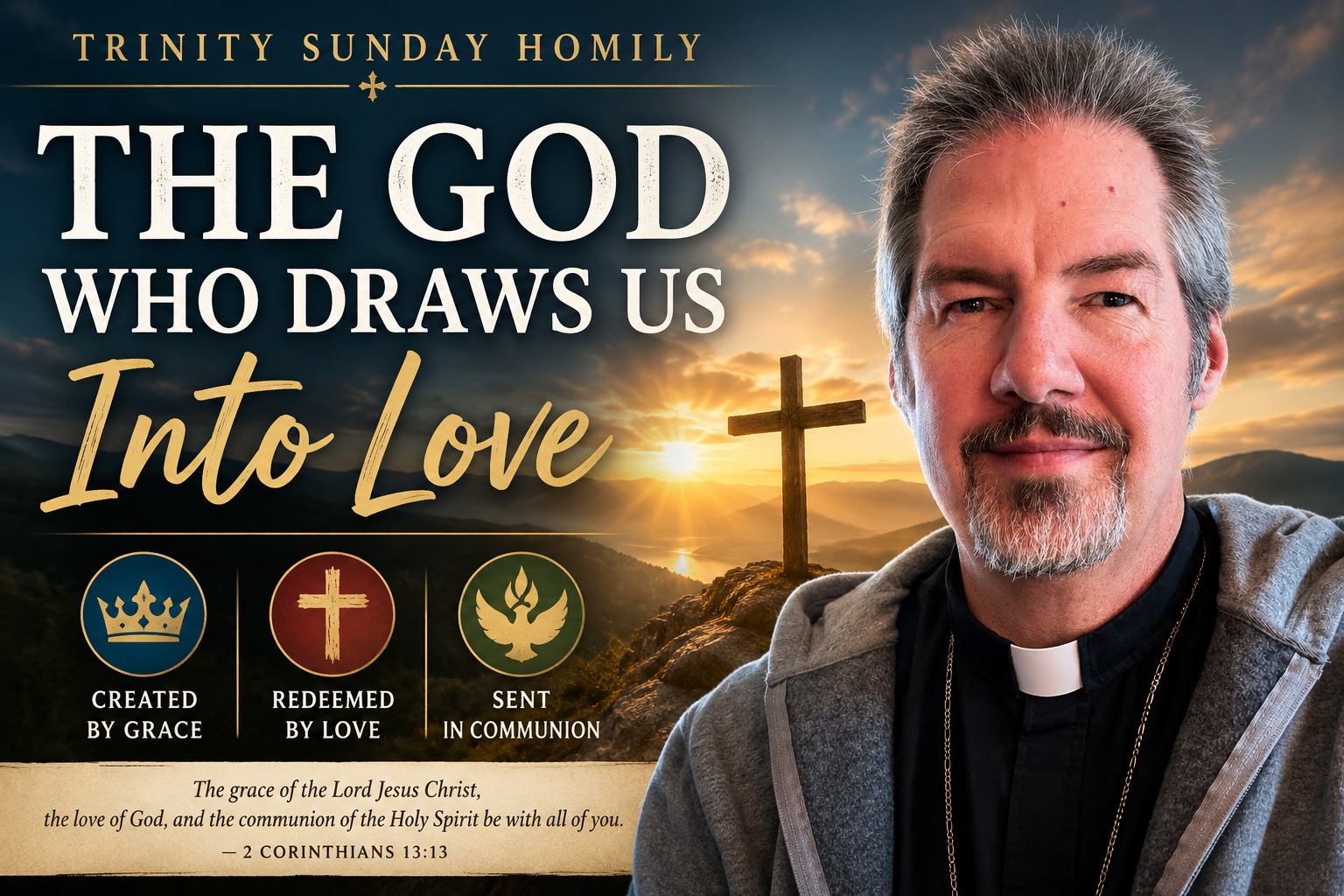
“The grace of the Lord Jesus Christ, the love of God, and the communion of the Holy Spirit be with all of you.”
There, in a single sentence, we glimpse the Trinity not as an abstract doctrine but as a living relationship of grace, love, and communion. The God revealed in Scripture is not solitary or isolated. God’s very nature is relationship, self-giving love flowing eternally between Father, Son, and Holy Spirit. If we are made in God’s image, then we too are made for relationship. We were never meant to live as isolated individuals. We were created for community, compassion, and mutual care.
The Gospel takes us to a mountain in Galilee. The risen Christ stands before his disciples one final time. It is a remarkable scene because Matthew tells us something that gives me great comfort: “When they saw him, they worshiped him; but some doubted.” Even standing before the risen Christ, some doubted.
There is good news in that little sentence. Faith has never required certainty about everything. Doubt is not the opposite of faith. More often than not, doubt is simply faith that is still asking questions. Jesus does not rebuke them. He does not send the doubters away. He gathers all of them, the confident and the uncertain alike, and entrusts them with the same mission.
“Go therefore and make disciples of all nations.”
Notice what Jesus does not say. He does not tell them to conquer nations. He does not tell them to dominate cultures or accumulate power. He sends them to make disciples, teaching people to follow his way of life. And what is that way? It is the way of love, mercy, forgiveness, justice, and reconciliation. It is the way revealed throughout his ministry and ultimately on the cross.
Then Jesus tells them to baptize in the name of the Father and of the Son and of the Holy Spirit. The mission of the Church begins and ends in the life of the Triune God. We are invited into the very relationship that has existed from all eternity, a relationship of grace, love, and communion. And then comes the promise that holds everything together:
“And remember, I am with you always, to the end of the age.”
The God who created the stars is with us. The Christ who conquered death is with us. The Spirit who renews the face of the earth is with us. That is the heart of Trinity Sunday. Not a mathematical formula. Not a theological riddle. A relationship.
The God who creates, redeems, and sustains all things invites us into divine life. The God whose image we bear calls us to reflect that love into the world. The God who sends us on mission promises never to abandon us.
In a world filled with division, fear, and loneliness, perhaps the Church’s greatest witness is simply to live as people shaped by that reality, to be communities of grace, love, and communion. To care for creation because it is God’s good gift. To honor one another because every person bears God’s image. To proclaim Christ not merely with our words but with our lives. And to remember, even when faith feels fragile and questions remain, that the One who sends us also walks beside us. For he is with us always, even to the end of the age.
Amen.