I suppose there are worse things to be remembered for than bare feet.
Over the years, I have worn many titles, some received with humility, some endured with a sigh, and some that never fit quite right no matter how carefully they were polished. Bishop. Archbishop. Abbot. Founder. Successor. Wanderer. Glassblower. Fool for Christ, at least on my better days.
But “the Barefoot Bishop” may be as close to the truth as any of them.
It began, at least in part, with the altar.
Not the idea of the altar as a stage, or a platform, or a ceremonial table around which ecclesiastical peacocks may gather in lace and brocade. I mean the altar as the holy place. The dangerous place. The place where heaven bends low enough to touch bread and wine, and where the priest ought to remember, trembling, that this is not his performance.
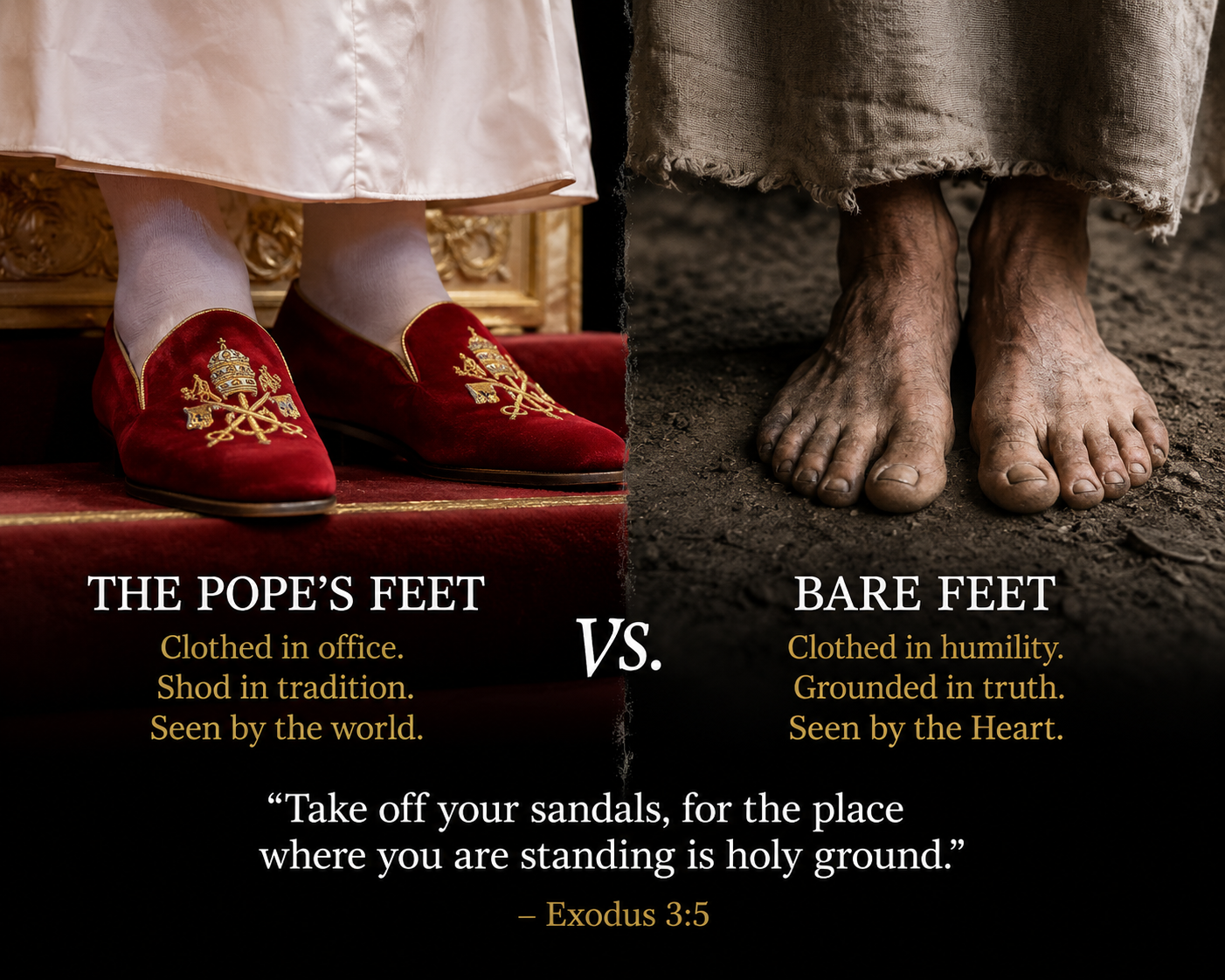
In Scripture, when Moses approaches the burning bush, the voice of God calls out to him: “Take off your sandals, for the place where you are standing is holy ground.” Before Moses can speak for God, before he can confront Pharaoh, before he can become the liberator of Israel, he must first become barefoot before mystery.
That has always stayed with me.
The Holy of Holies in the Temple was not a place for swagger. It was not a place for vanity. It was the innermost sanctuary, the place of divine presence, approached with fear, reverence, repentance, and awe. The priest did not enter that place casually. He entered as one accountable to God, carrying not his own importance, but the prayers and sins and hopes of the people.
For me, the Eucharistic celebration carries something of that same trembling intimacy. I am not saying the altar is the Holy of Holies in a simplistic or wooden way. Christ has opened the veil. The mystery is no longer locked away behind temple curtains. But still, something remains. Something holy. Something before which the soul ought to remove its shoes.
When I stand at the altar, I stand where earth and heaven kiss. I stand where Christ gives himself again and again, not as spectacle, not as ecclesiastical theater, but as food for the weary, medicine for the wounded, mercy for sinners, and fire for the cold-hearted.
So yes, I always celebrate the Holy Mysteries barefoot.
Not because I think everyone must. Not because it makes me holier. God forbid. I know myself too well for that. I do it because I need the reminder. I need to feel the ground beneath me. I need to remember that the altar is not mine. The Church is not mine. The priesthood is not mine. The episcopacy is not mine. The ministry is not mine.
All of it is a gift. All of it is borrowed flame.
There is also an ancient and honorable echo here in the tradition of the discalced religious orders. The word “discalced” simply means unshod or barefoot. Certain Carmelites, Franciscans, Augustinians, and other religious embraced bare feet or simple sandals as a sign of poverty, humility, repentance, and reform. They refused comfort as an idol. They stripped away status. They chose the rough road, at least symbolically, because Christ walked among the poor, not above them.
Barefoot spirituality is not about drawing attention to the feet. It is about removing whatever comes between the servant and the ground of humility.
Shoes, after all, are useful things. But they can also become symbols of rank, polish, procession, and presentation. Sometimes the soul needs to step out of them.
I learned rather quickly that not everyone appreciates this.
Some years ago, I was invited to an ordination by a man who was assembling what might gently be called a “who’s who” of bishops in the Independent Sacramental Movement. It was to be one of those grand affairs, heavy with titles, vestments, lineages, claims, subclaims, and the usual fluttering of ecclesiastical feathers.
He was especially eager, I was told, to have the successor of Bishop Karl Prüter present. That would be me.
Now, I say that with reverence, not vanity. Bishop Karl was a man of deep importance in our little corner of the sacramental world, and to be connected to his ministry is no small thing. I have tried, however imperfectly, to keep faith with that inheritance. I have tried to keep alive what was generous, pastoral, peace-filled, Christ-centered, and stubbornly hopeful in his work.
So, at first, my presence was desirable.
Then he saw me celebrate Mass later that evening.
Barefoot.
Apparently, that was a bridge too far.
Never mind the Eucharist. Never mind the prayers. Never mind Christ present among us in bread and wine. Never mind the ancient memory of Moses before the burning bush or the long witness of barefoot religious who chose simplicity over display. What mattered, it seems, was that my bare feet offended the aesthetic expectations of the episcopal guest list.
He thought it unsightly.
Soon enough, I found myself uninvited.
And to tell the truth, I was relieved.
There are moments in life when rejection feels like deliverance. This was one of them. I had not wanted to be part of that clerical circus anyway.
I do not say that to be cruel. I know the Independent Sacramental Movement. I love it, in my own way. It has given shelter to strange birds, wounded priests, exiled mystics, liturgical craftsmen, sincere seekers, and more than a few holy fools. It has also, Lord have mercy, provided a home for spiritual ambition dressed up in cope and miter, and ruby red slippers. (Forgive me Pope Benedict XVI and of course Judy Garland!)
We have all seen it. Processions without humility. Titles without service. Lineages without love. Vestments without sacrifice. Apostolic succession treated less like a sacred trust and more like a collector’s certificate.
That is not the Church. That is religious cosplay with incense.
The episcopacy is not meant to be ornamental. A bishop is not called to be impressive. A bishop is called to guard the faith, feed the people, tend the wounded, reconcile the estranged, speak truth, protect the vulnerable, and stand before God with empty hands.
Bare feet help me remember that.
They remind me that I am dust, beloved dust, but dust all the same. They remind me that the ground is holy long before I arrive. They remind me that Christ knelt to wash feet, not to admire shoes. They remind me that the people of God do not need another polished prince of the sanctuary. They need shepherds who smell like the sheep, servants who know the road, and priests who can still feel the earth beneath them.
The barefoot bishop isn’t a gimmick. It’s a confession.
It says I have no desire to climb the ladder of religious importance. I have climbed enough ladders in my life to know that height is mostly useful when there is work to be done. It says I would rather stand close to the poor than posture among the powerful. It says I would rather be found faithful in a small chapel, at a humble altar, among the bruised and beloved, than admired in some grand procession of self-appointed princes.
And it says, most of all, that when we come to the Eucharist, we come to holy ground.
We come not as owners but as guests. Not as performers but as witnesses. Not as spiritual celebrities but as beggars who have found bread.
The altar doesn’t need my shoes.
It calls for my reverence. It calls for my repentance. It calls for my willingness to disappear behind the mystery of Christ.
So yes, I am the Barefoot Bishop.
Not always literally, perhaps. There are times and places where shoes are useful, merciful, or simply required by common sense. But spiritually, I hope to remain unshod. I hope to keep approaching the altar as Moses approached the flame, aware that the ground beneath me has already been claimed by God.
And if that offends the ecclesiastical fashion police, so be it.
The Church has survived worse than bare feet.
What it may not survive is pride dressed up as holiness.
As for me, I will stand, bare feet and all, on holy ground. My soul will feel the sacredness through the soles of my feet. I will receive the bread and wine with trembling hands. I will walk with the poor, the wounded, the wandering, and that strange, blessed company who know that grace rarely arrives wearing polished shoes.
I will stand barefoot before the mystery.
And I will be glad.