
Acts 2:1-21
Psalm 104:25-35,37
1 Corinthians 12:3b-13
John 20:19-23
There is a particular kind of fear that causes people to lock the doors. Not just the doors of houses, but the doors of hearts, communities, imagination, and hope. The Gospel today opens in exactly that kind of room. The disciples are gathered behind locked doors after the crucifixion of Jesus. The world they thought they understood has collapsed. Rome is still Rome. The religious authorities still hold power. Their teacher has been executed publicly and violently. They are frightened, uncertain, and trying to figure out what comes next, so they lock the doors. Honestly, who can blame them?
We know something about locked doors these days. We know what it is to live in anxious times. We know the temptation to retreat into fear, cynicism, tribes, and ideologies that promise safety. We know how easy it is to shrink our world down to whatever feels manageable and controllable. But then something extraordinary happens. Jesus comes anyway. Not after they become brave, not after they figure everything out, not after they finally get their faith together. He simply appears among them and says, “Peace be with you.” Not condemnation. Not shame. Peace.
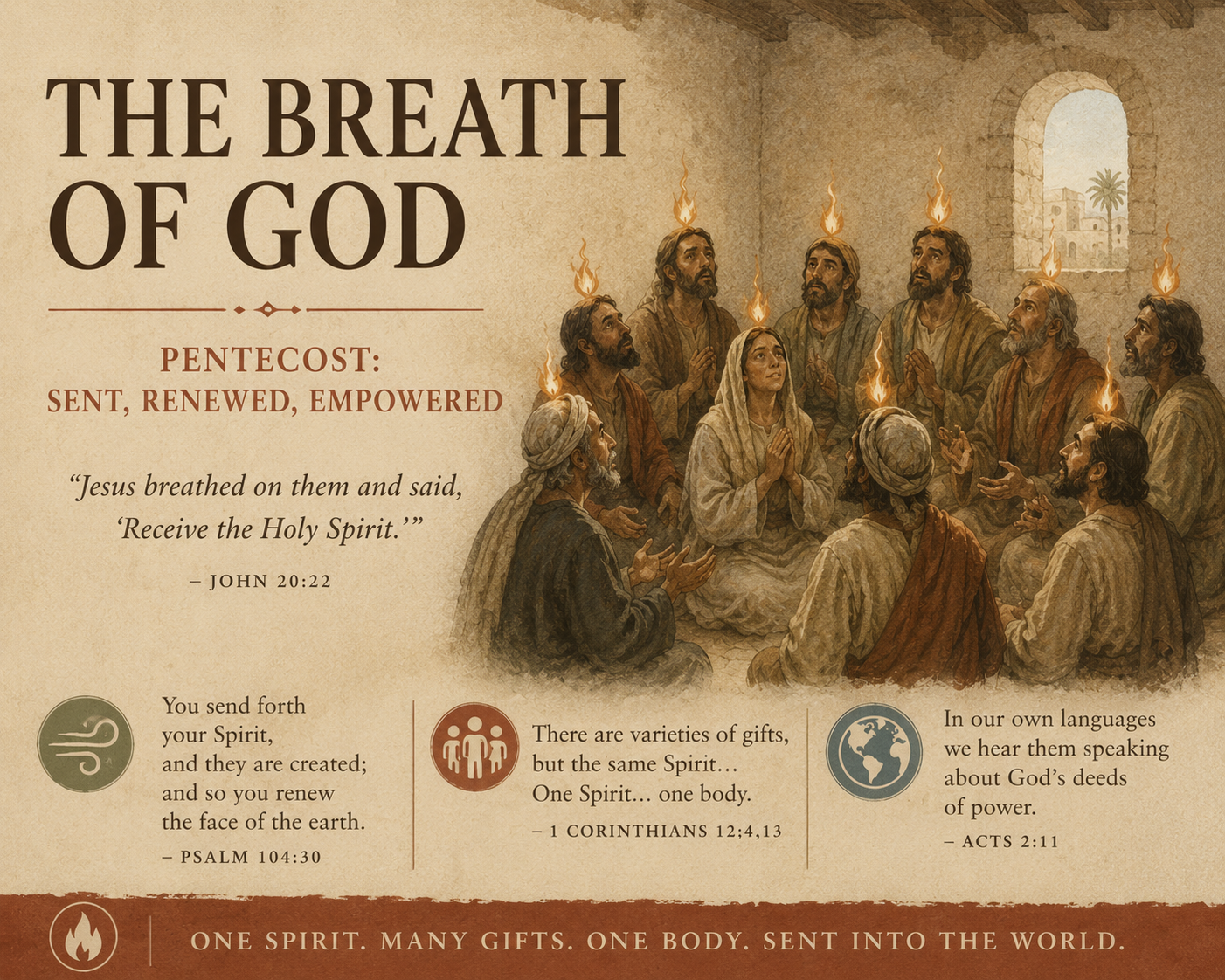
Then John tells us something profoundly beautiful. Jesus breathes on them and says, “Receive the Holy Spirit.” The breath of God. That phrase echoes all the way back to Genesis, when God breathed life into the first human being. It echoes Ezekiel’s vision of dry bones rising as breath enters them again. And now here is the risen Christ breathing new creation into frightened disciples hiding behind locked doors. Pentecost is not merely about excitement or spectacle. It is about God breathing life back into people who had forgotten how to hope.
In Acts, the Spirit arrives with noise and fire and wind. The disciples are gathered together when suddenly the house shakes with the sound of a rushing violent wind. Tongues of fire rest upon them, and ordinary people begin speaking in languages they do not even know. It is chaotic and beautiful and more than a little unsettling. Maybe that is exactly the point, because the Holy Spirit refuses to stay locked inside rooms, systems, traditions, or institutions. The Spirit spills outward.
The crowd gathers, bewildered, because people from every imaginable nation and language suddenly hear the Gospel in their own tongue. The miracle of Pentecost is not uniformity. It is understanding. The Spirit does not erase differences. The Spirit speaks through them. Parthians, Medes, Egyptians, Arabs, Romans, and others all hear the mighty works of God in the language of their own hearts. This is the reversal of Babel. Human pride once divided humanity into confusion and fragmentation. Now the Spirit moves toward reconciliation and communion.
Peter stands up, no longer hiding behind locked doors, and says, “This is what was spoken through the prophet Joel.” Your sons and daughters shall prophesy. Your young men shall see visions. Your old men shall dream dreams. Not just priests, not just kings, not just religious elites. All flesh. The Spirit of God is poured out generously, extravagantly, beyond the boundaries people once thought permanent. That remains unsettling to religious people in every age because we prefer controlled fire, predictable wind, and a manageable God. But Pentecost reminds us that the Spirit blows where it will.
Psalm 104 widens the lens even further: “You send forth your Spirit, and they are created; and so you renew the face of the earth.” The Spirit is not merely active in churches. The Spirit is woven into creation itself. The Psalmist looks at oceans, mountains, creatures, storms, and stars and sees a world alive with the breath of God. The Spirit is not only the comforter of souls; the Spirit is the renewer of creation. We desperately need that reminder now, because there are many voices telling us that the world is doomed, that humanity is irreparably fractured, and that cruelty and greed will always prevail. But the Psalm insists that God is still renewing the face of the earth. Not abandoning it. Not discarding it. Renewing it.
Paul takes that same truth and brings it into the life of the Church. “There are varieties of gifts,” he says, “but the same Spirit.” Not everybody is called to do the same thing. Not everybody carries the same gift. Wisdom, healing, discernment, prophecy, service, all flow from the same Spirit for the common good. That matters because churches often forget this. Communities forget this. We begin demanding sameness instead of unity. But the Spirit delights in diversity. The Body of Christ was never meant to be a collection of identical parts. A body needs eyes and ears and hands and feet. It needs contemplatives and prophets, healers and teachers, peacemakers and truth tellers. Every gift matters, especially the ones the world overlooks.
So we return to that locked room in the Gospel. Jesus enters the fear and breathes peace. Then he says something just as important: “As the Father has sent me, so I send you.” The Spirit is never given merely for private comfort. The Spirit sends us outward. The frightened disciples become courageous witnesses. The locked room becomes a launching place. Fear becomes mission. That remains the calling of the Church: not to hide behind locked doors, not to retreat into fear or tribal certainty, but to become people through whom the breath of God moves into the world.
We are called to carry peace into violent places, speak hope into despair, and forgive in a culture addicted to condemnation. Pentecost is not just about what happened then. It is about what is still happening now. The Spirit is still being poured out. The wind is still blowing. The fire is still burning. Christ is still standing among frightened people saying, “Peace be with you.” Receive the Holy Spirit, and then go.
Amen.