

The Gospel According to Roddenberry: AI, Star Trek, and the Road Beyond Scarcity
By +Brian Ernest Brown, CWC
I’ve loved Star Trek since I was a young child. It wasn’t merely entertainment to me. It offered a vision of what humanity might become if we could outgrow some of our fear, prejudice, greed, and tribalism. It imagined a future in which our differences weren’t erased but brought together in a shared search for knowledge, peace, and understanding. Over the years, I’ve come to call this vision, somewhat playfully, the “Gospel of Roddenberry.”
I don’t mean “gospel” in the religious sense, nor do I imagine Gene Roddenberry to have been a prophet whose every prediction will come true. I mean that Star Trek proclaimed good news about the human possibility. Beneath the starships, alien civilizations, and futuristic technology was a stubbornly hopeful conviction: humanity could grow up. We could become more peaceful, more curious, more inclusive, and less controlled by the struggle for wealth and power.
Not everything Roddenberry imagined has come true, and some of it probably never will. Nevertheless, much of the Star Trek universe is emerging around us in one form or another. We carry handheld communicators far more capable than those used aboard the original Enterprise. We speak to computers, consult worldwide libraries from our homes, hold meetings across continents, use medical scanners, translate languages almost instantly, and increasingly collaborate with intelligent computer systems.
We don’t yet have warp drive, transporters, or true replicators. But I believe we’re moving along the same general trajectory: toward greater technological abundance, deeper interconnection, and a world in which machines can increasingly relieve human beings of burdens that once seemed unavoidable.
Whether that journey produces the humane future envisioned by Star Trek remains an open question. Technology can give us greater power, but it cannot guarantee greater wisdom. That part remains our responsibility.
It’s from within this lifelong love of Star Trek and my belief in the hopeful humanism of the Gospel of Roddenberry that I approach artificial intelligence.
I’ve been struck by the number of Star Trek enthusiasts, many of them politically liberal or progressive, who have become firmly opposed to artificial intelligence. I understand many of their concerns. AI can be exploited by corporations, used to eliminate jobs without protecting workers, employed to spread misinformation, and developed without sufficient accountability. Those dangers are real and shouldn’t be dismissed. Still, I detect a measure of cognitive dissonance.
For generations, Star Trek has offered an optimistic vision of humanity’s future. It imagines a society that has moved beyond poverty, hunger, and the relentless struggle for material survival. People are no longer forced to spend most of their waking lives earning enough money merely to remain alive. They are free to pursue knowledge, creativity, service, exploration, relationships, and personal development.
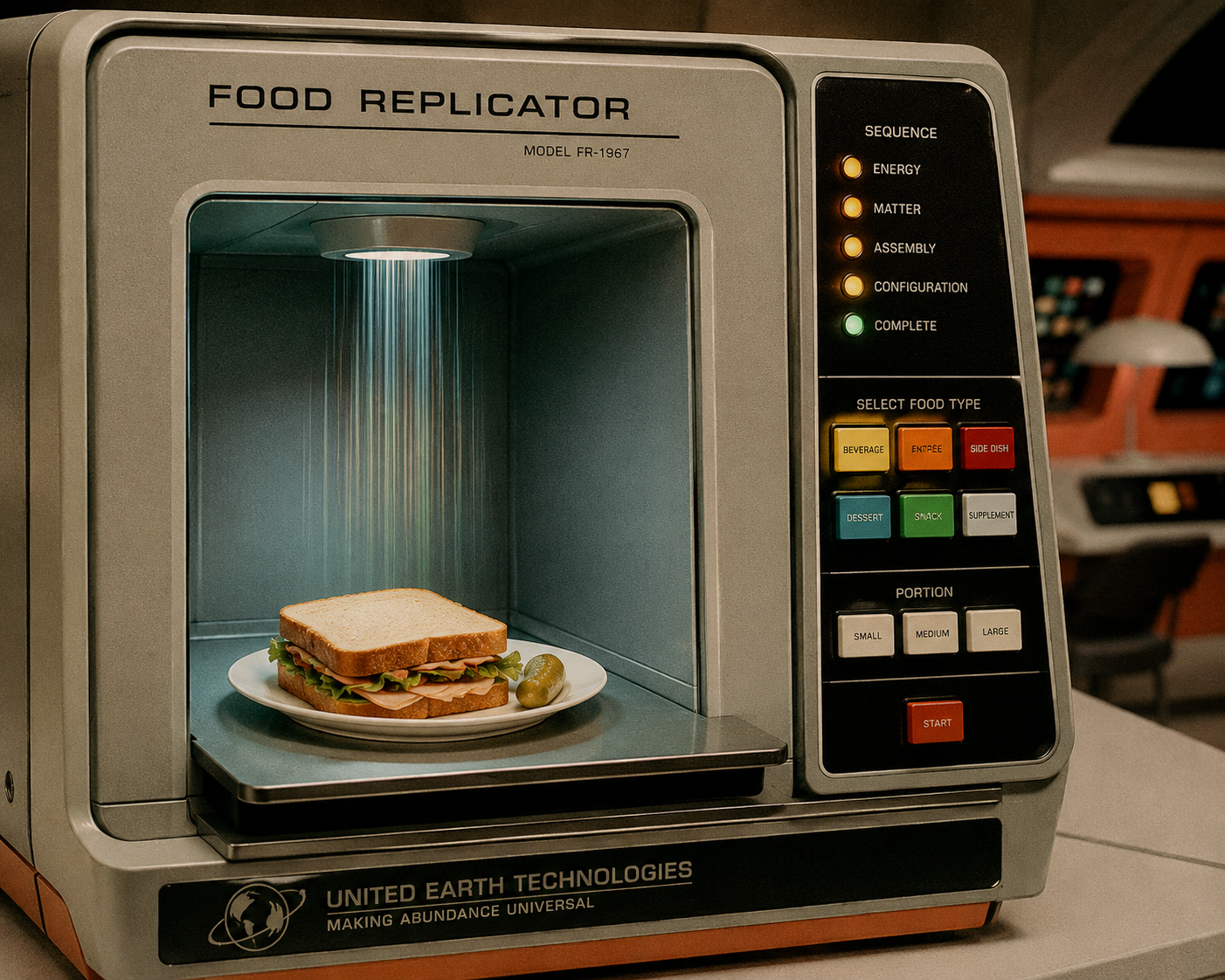
One of the technologies that made this future possible was the replicator. When food, clothing, tools, and many other necessities could be produced on demand, scarcity lost much of its power. The replicator helped level the field between those who possessed wealth and those who didn’t. Together with abundant energy, automation, and an extraordinarily advanced computer network, it helped make a largely non-monetary human economy possible.
The replicator didn’t merely make dinner appear. It helped break the old connection between human worth and economic productivity.
That distinction matters. In our present society, people are often valued according to the labor they can sell. If they cannot work, cannot find work, or cannot perform the kind of work the market rewards, their basic security is threatened. We’ve built a world in which the right to eat, rest, receive medical care, and have shelter remains tied to one’s ability to generate income. Star Trek asks us to imagine something better.
Artificial intelligence may be one of the early technologies capable of moving us in that direction. It can take over repetitive, dangerous, and mentally exhausting tasks. It can make knowledge and sophisticated tools available to people who previously couldn’t afford them. It can help individuals write, design, research, translate, calculate, organize, and create without requiring years of specialized training or an enormous budget.
I’m not a professional graphic artist, but I have a good artistic eye and decades of experience as an artist/crafter/maker. AI allows me to bring that vision into a collaborative process and produce professional-quality graphics in minutes. The machine doesn’t supply the purpose, taste, judgment, or imagination. I bring those things. AI helps me translate what I can envision into something others can see. That doesn’t make me less creative. It gives my creativity another instrument.
The same was once said of photography, recorded music, synthesizers, digital publishing, and computer-assisted design. New tools disturb established boundaries. They allow people outside the old guilds to do things that once required expensive equipment, institutional access, or years of technical training. That disruption can feel threatening, particularly to those whose livelihoods depend upon those boundaries. But democratizing a human capacity isn’t the same as destroying it.
The real danger isn’t that AI will relieve people of menial labor. The danger is that our economic system will use AI to relieve people of their incomes while leaving their need for food, housing, healthcare, and dignity unchanged. If the benefits of automation belong only to a handful of corporations and investors, AI will deepen inequality. If its benefits are shared, it could reduce drudgery and return something precious to ordinary people: time.
That makes the central question political and moral, not merely technological. Who will own these systems? Who will benefit from their labor? Will increased productivity mean shorter working hours and greater security, or merely fewer workers and larger corporate profits? Will AI become another instrument of domination, or part of the machinery of liberation?
Technology alone won’t create the humane future imagined by Star Trek. The fictional Federation didn’t emerge merely because someone invented a replicator. Humanity also had to develop a different understanding of wealth, work, dignity, and the common good. Material abundance required moral development. That remains true for us.
AI isn’t the Federation’s computer, and today’s automated systems aren’t replicators. We’re standing near the beginning of the road, not its destination. But it seems strange to celebrate a future in which intelligent computers and automation liberate humanity while condemning their earliest ancestors simply because their arrival unsettles the present order.
The answer isn’t to halt development and preserve every form of labor forever. Human beings weren’t born to spend their lives performing tasks that machines can safely and efficiently perform. The answer is to ensure that when machines assume more of the burden, ordinary people receive more of the freedom.
If AI can help release humanity from drudgery, democratize sophisticated forms of creation, and give people more time to become fully actualized human beings, then it deserves more than fear. It deserves thoughtful development, democratic oversight, ethical boundaries, and a fair distribution of its benefits.
The future promised by Star Trek was never a future without technology. It was a future in which technology had finally been placed in the service of human flourishing. That’s the future worth defending.