

Project 2028: A Way Forward
By +Brian Ernest Brown, CWC
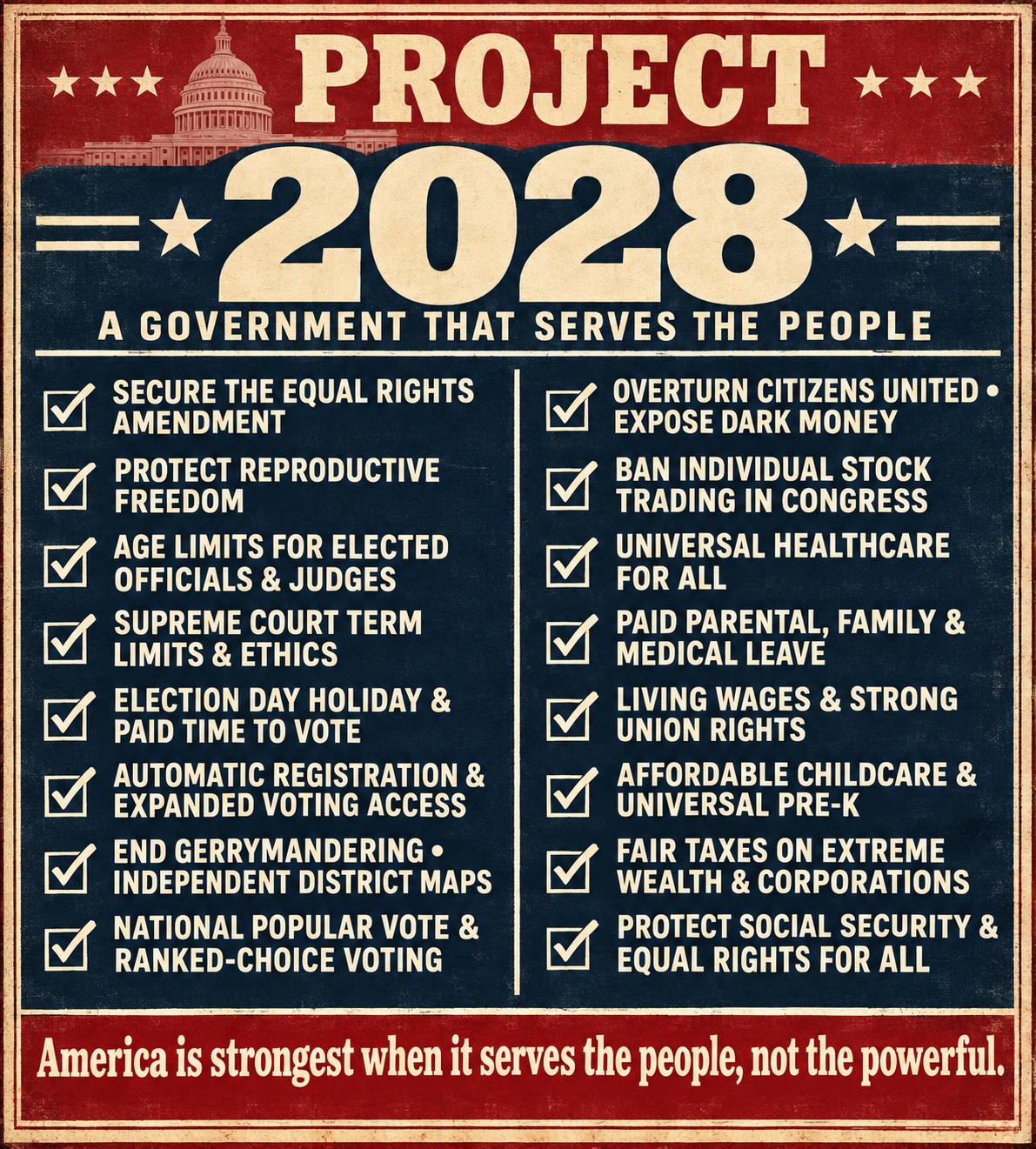
There’s a reason I’m sharing this Project 2028 graphic. I don’t necessarily regard every line as a finished policy proposal, and a meme certainly isn’t a substitute for the patient work of governing. But it offers a place to begin a conversation about whom our government serves and what we ought to expect from it.
For me, the most important line is at the bottom: “America is strongest when it serves the people, not the powerful.” That’s the thread running through the whole thing. Before we get caught up in which proposals belong to the left or the right, I think we need to ask a more basic question. Who benefits from the way things are, and who keeps paying the bill?
I’ve come to believe that the struggle we’re facing is increasingly one of top versus bottom. People with ordinary incomes are encouraged to fight one another over party labels while concentrated wealth and political influence remain comfortably out of reach. Meanwhile, the person stocking shelves, teaching children, caring for patients, or trying to keep a little shop open is wondering whether there’ll be enough left at the end of the month. Those concerns cross an awful lot of political boundaries.
I know something about that last one. I make things with my hands and sell them for a living. There’s nothing abstract about the cost of materials, the rent coming due, or a customer who admires something but simply can’t afford it. An economy can look wonderful from a considerable height while being a daily struggle for the people standing on the ground. I want our politics to spend more time down here.
That doesn’t mean every wealthy person is an enemy or every struggling person has the same interests. It means we should be honest about the relationship between money and power. When wealth buys greater access to lawmakers, greater influence over public debate, and greater protection from the consequences of bad decisions, something has gone wrong with the democratic promise. A person’s voice shouldn’t depend on the size of their investment portfolio.
This is where my understanding of the via media comes into the conversation.
I’ve never understood the middle way as an obligation to stand halfway between whatever positions happen to be shouting at each other. If one position moves further toward an extreme, we don’t have to follow it halfway down the road to prove we’re reasonable. That would leave our convictions entirely at the mercy of somebody else’s movement.
Over the years, I believe that’s part of what has happened to our political center. The range of what we’re told is practical, respectable, or politically possible has been pushed further to the right. Basic commitments to public welfare can then be treated as radical demands, and people advocating them are expected to retreat before the conversation even begins. Calling the resulting compromise “the center” doesn’t make it a sound place to stand.
The center I’m interested in has roots. It rests on human dignity, equal protection under the law, democratic accountability, personal liberty, and a shared responsibility for the common good. It asks something of the individual and something of the community. It recognizes that freedom requires room to make our own choices, along with conditions that give those choices some substance.
A parent who can’t take time off after the birth of a child has limited freedom in practice. So does a worker who’s afraid to seek medical care because of the bill. So does someone whose opportunity to vote depends on whether they can afford to miss a shift. Paid family leave, accessible healthcare, and meaningful access to the ballot belong in a serious conversation about liberty.
From that foundation, I want us to develop healthy liberal and conservative parties. We need both traditions to bring their best judgment to the table.
A healthy liberal tradition asks whom we’ve excluded, whose suffering we’ve learned to overlook, and which institutions need to change. It keeps pressing us to widen opportunity and bring our practices into better alignment with our promises. At its best, it refuses to let familiarity become an excuse for injustice.
A healthy conservative tradition asks what we’ve inherited that deserves protection, what holds communities together, and what consequences might follow a proposed change. It reminds us that institutions carry accumulated experience, that relationships matter, and that good intentions need careful implementation. At its best, it brings stewardship, continuity, and restraint.
There’s a useful tension between those instincts. Reform needs scrutiny. Preservation needs scrutiny too. A society needs the courage to repair what’s broken and the wisdom to recognize what’s still carrying weight. That work becomes possible when people can challenge one another without assuming that disagreement makes them enemies.
I work with glass. I know what happens when stress is poorly managed. Something can look perfectly sound and still carry the conditions of its own fracture. Our public life needs the equivalent of careful annealing: time, patience, and conditions that allow the strain to settle. Constant outrage and hurried retaliation won’t produce sturdy government.
Neither will pretending that every dispute has two equally defensible sides. Equal citizenship has to be part of the foundation. So do honest elections, peaceful transfers of power, and the right to disagree without intimidation. The healthy tension I’m describing requires a shared commitment to the structure itself. We can argue vigorously about how to furnish the house while agreeing that everyone belongs under its roof.
That’s how I’d approach the proposals in this graphic. Secure equal rights. Protect reproductive freedom. Make it easier for citizens to vote. Address the influence of money in elections. Establish meaningful ethical standards for public officials and judges. Help families care for their children and one another. Protect workers’ ability to earn a decent living and older people’s ability to live with dignity.
There’s plenty to debate within that agenda. Age limits deserve a careful discussion about experience, capacity, and the orderly renewal of leadership. Healthcare proposals need workable financing and administration. Tax policy needs to support public responsibilities while accounting for its effects on businesses and households. A good purpose deserves the effort required to make it work.
I’d welcome a conservative contribution that helps make paid family leave practical for small employers. I’d welcome a liberal contribution that identifies who would still fall through the cracks. Let them challenge the numbers, examine the consequences, and improve the proposal. That’s the kind of disagreement that can leave us with something stronger than either side brought into the room.
As a Christian, I come to these questions with a particular concern for people who are easily overlooked. I don’t expect every citizen to share my faith, and I have no interest in making religious agreement a condition of belonging. My faith does, however, require me to take my neighbor’s life seriously. It won’t let me measure the health of a nation solely by the comfort of those doing best.
Project 2028 can be an invitation to recover that sense of responsibility. We need a public life in which ordinary people can recognize their own concerns, participate without having to purchase access, and expect something more useful than another round of carefully staged hostility.
I want a sturdy table, room for honest disagreement, and people willing to do the work. I want liberal imagination and conservative consideration brought into a conversation whose purpose is good government. And I want the people who’ve been standing outside, paying the bills and waiting to be heard, to have a proper seat at it.