
Every generation seems convinced it is witnessing the invention that will finally undo civilization. Today, of course, that invention is artificial intelligence.
Spend a few minutes on social media and you’ll quickly discover two competing camps. One insists AI will save the world. The other is equally convinced it will destroy it. Between those two extremes sits the rest of us, trying to sort through the excitement, the fear, the promise, and the uncertainty.
And if truth be told, anyone who knows me has heard me affectionately refer to computers, cell phones, or just about any piece of modern technology as “tools of the devil!” Usually that declaration comes right after an update has rearranged everything I finally figured out, or after I’ve spent twenty minutes trying to solve a problem only to discover I’d overlooked something embarrassingly simple. It’s become a standing joke around me. The irony, of course, is that after all my grumbling, I’m usually the first one eager to explore what the next new piece of technology might make possible.
The truth is, we’ve been here before. Many, many times really. History has a remarkable way of repeating itself, not because the inventions are the same, but because we are.
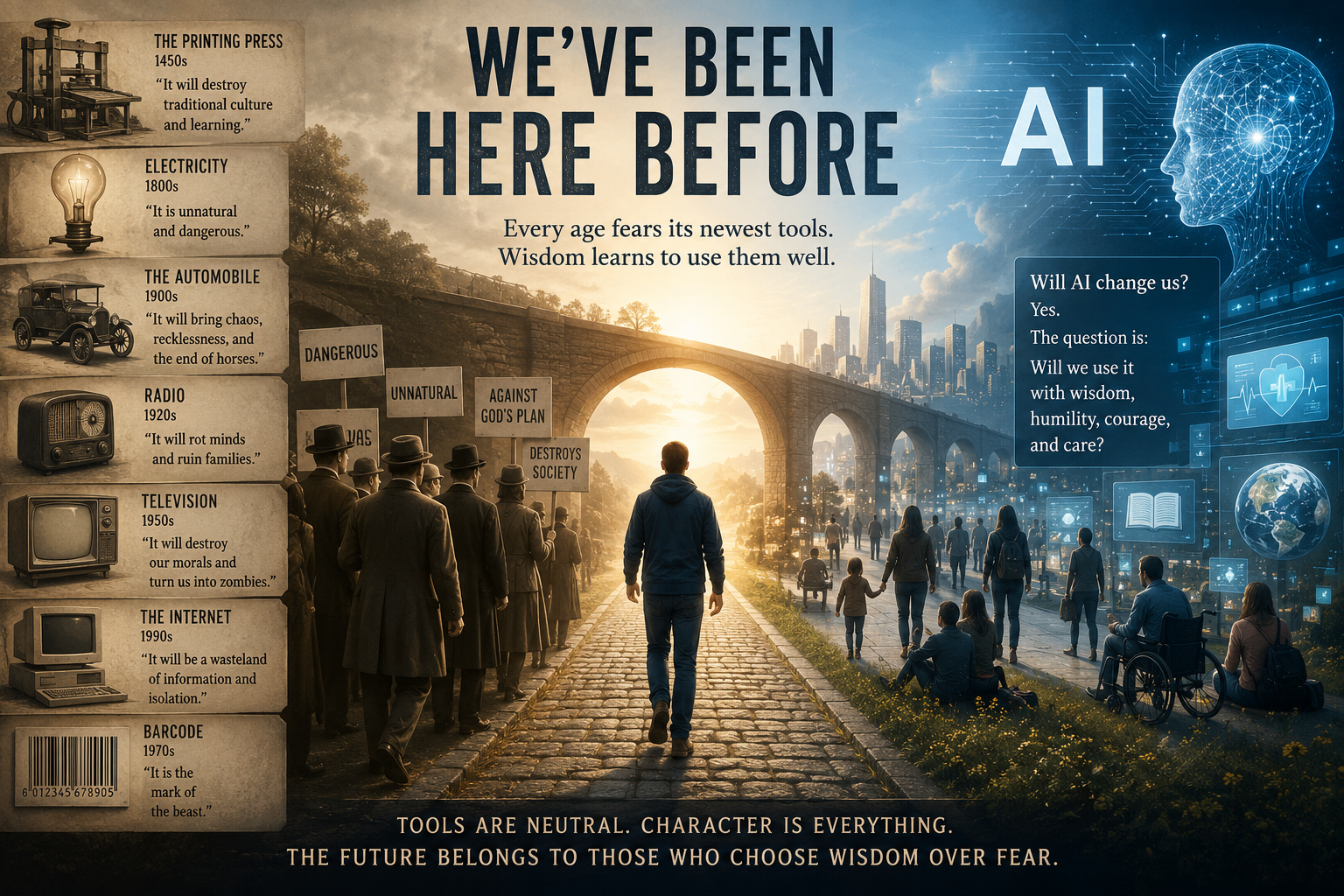
When Johannes Gutenberg introduced the movable-type printing press in the fifteenth century, it changed the world forever. Before that, books were copied painstakingly by hand. Knowledge belonged largely to monasteries, universities, and the wealthy. Suddenly books could be reproduced by the hundreds and eventually by the thousands and that terrified some people.
Scribes feared the loss of their livelihoods. Religious and political authorities worried that ordinary people, now able to read for themselves, might begin asking dangerous questions. They weren’t entirely wrong. The printing press fueled the Renaissance, the Reformation, the Scientific Revolution, and eventually the Enlightenment. It democratized knowledge in ways no one could have fully imagined. The press didn’t merely print books. It redistributed power and ultimately wealth.
Centuries later came electricity. Imagine trying to explain electric light to someone living in the 1850s. Invisible energy traveling through wires? Homes illuminated without candles or oil lamps? Entire cities awake long after sunset? To many people it sounded unnatural, perhaps even dangerous. Early electrical accidents only reinforced those fears. Yet today we hardly give a second thought to flipping a switch.
Then came the automobile. Many believed horseless carriages were reckless machines that would terrify livestock, destroy communities, and make travel impossibly dangerous. Some municipalities imposed speed limits so slow that a person could nearly outrun the vehicles on foot. Others insisted they would never replace horses.
Then came radio. People worried families would stop talking to one another. Then television. It would rot children’s minds, destroy literacy, and bring moral decay into every living room. Then calculators. Students would never learn mathematics again. Then personal computers. Then the internet.
Each new technology arrived carrying remarkable promise and genuine risk. Each one inspired prophets of doom and evangelists of progress. Each one changed society in ways few people accurately predicted. None of them turned out to be entirely good but none of them turned out to be entirely evil. They simply became tools, reflecting both the wisdom and the foolishness of the people who used them. Somewhere along the way another curious fear emerged.
I still remember hearing people insist that the newly introduced barcode was the Mark of the Beast described in the Book of Revelation. Grocery stores, they warned, were preparing the way for the Antichrist. Every package, every can of soup, every box of cereal seemed to carry prophetic significance. Eventually the barcode became so ordinary that we hardly notice it anymore, except perhaps when it refuses to scan at the checkout counter.
Now all of this doesn’t mean that every concern was foolish. Every new technology deserves thoughtful scrutiny. Nuclear energy gave us both electricity and nuclear weapons. Social media has connected distant friends while simultaneously feeding loneliness, outrage, misinformation, and addiction. The internet has become one of humanity’s greatest libraries and, at times, one of its loudest echo chambers.
Technology is rarely the villain. Nor is it the hero. It’s an amplifier. It magnifies whatever already lives within us. A hammer can build a home or become a weapon. Fire can warm a family or burn down a forest. The same technology that allows a surgeon to save a life may allow someone else to take one. The moral question has never belonged to the tool itself. It has always belonged to the hands that hold it.
Artificial intelligence is no different. Will it eliminate certain jobs? Almost certainly. So did the printing press. So did mechanized farming. So did the assembly line. So did computers. Will it be abused? Undoubtedly. Every powerful technology has been. Will it also cure diseases, accelerate scientific discovery, make education more accessible, assist artists, help people with disabilities, and solve problems we haven’t yet imagined? Almost certainly.
The question before us has never really been whether technology changes the world, of course it does. The deeper question is whether we will allow technology to change us for the better. Will we become more compassionate or merely more efficient? Will we become wiser or simply faster? Will we use these new tools to deepen our humanity or to diminish it?
As a Christian, I don’t fear artificial intelligence nearly as much as I fear wilfull stupidity. History has taught me that human beings have an extraordinary capacity to misuse almost anything. We’ve weaponized religion, politics, science, education, and even love itself. Artificial intelligence will not introduce evil into the world. We accomplished that long before computers existed.
What AI does offer is another opportunity to decide what kind of people we intend to become. Every age inherits new tools. Every generation must decide how to use them. The real question has never been whether technology will reshape the world. The real question is whether we will meet that future with wisdom instead of panic, discernment instead of conspiracy, humility instead of arrogance, and courage instead of fear.
We’ve been here before. History suggests we’ll get through this one, too. The future has always belonged not to those who feared every new invention, nor to those who embraced every novelty without question, but to those who learned to hold innovation in one hand and wisdom in the other.