
The Thorns Are Our Refuge
By +Brian Ernest Brown, CWC
My personal ecclesial crest is more than a collection of church symbols dressed up in heraldry. It’s something of a spiritual autobiography. It tells the story of where I’ve been, what has shaped me, and the kind of ministry I’ve tried to offer throughout my life. It isn’t the story of a straight road or a steady climb through the ranks of the Church. My road has wandered through different religions, traditions, and denominations, through parish churches, mission stations, seminaries, independent jurisdictions, monastic communities, and more than a few briarpatches. Still, one calling has remained steady through it all: to help make sanctuary for the least, the lost, the marginalized, and those whom the world has tossed aside.
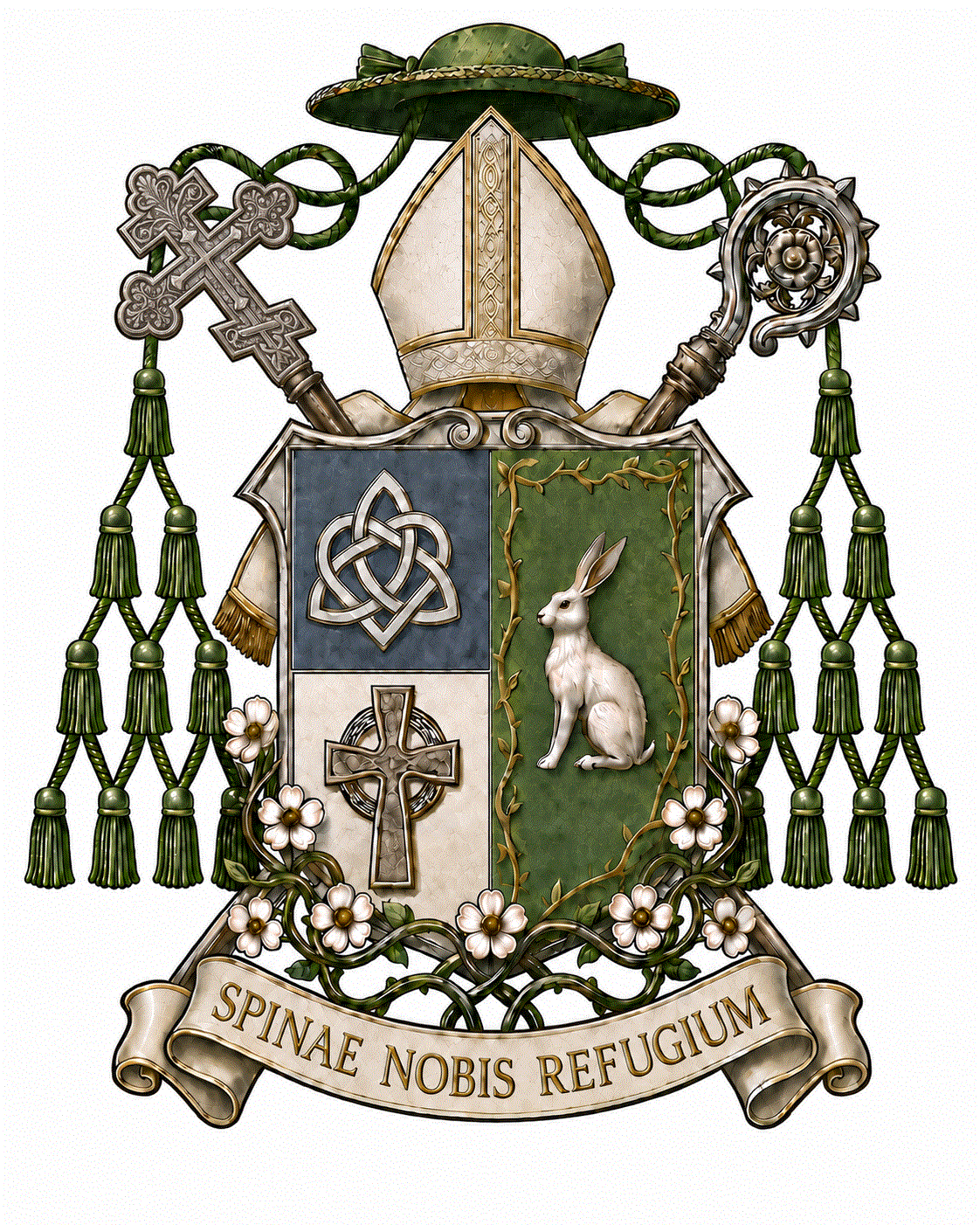
At the top of the crest rests the green ecclesiastical hat, with its cords and tassels. It places the crest within the Catholic tradition and represents the episcopal ministry entrusted to me as a bishop of the Church. I don’t see it as a crown, though. I see it as a reminder that a bishop is tied to the people. Every cord is a connection, every tassel an obligation. A bishop isn’t meant to float above the Church like some fancy ornament. A bishop belongs among the people, especially those standing out along the edges of the highways and hedges wondering whether there is room for them.
The green speaks of hope, growth, and ordinary time. Most ministry doesn’t happen in grand cathedrals or at great historic moments. It happens in ordinary time, around kitchen tables, in little chapels, over telephone calls, in hospital rooms, through letters, emails, instant messaging, and in quiet conversations with people trying to hold their lives together. Green is the color of things growing slowly, often when nobody is paying much attention. It is the color of life returning after a hard winter.
Beneath the hat are the miter, crozier, and processional cross. The miter represents the responsibility to teach and guard the faith, but never to guard it so tightly that nobody can get near it. The faith isn’t a club to beat people with, nor is doctrine meant to become a stone wall around God’s mercy and love. The truth of Christ is meant to set people free.
The crozier is the shepherd’s staff. It speaks of guidance, care, and protection, but it also speaks of going out to look for those who are missing. A shepherd who only tends the sheep already standing safely in the pasture isn’t doing the whole job. Sometimes ministry means heading out into the brush, listening for a frightened voice, and crawling through the thorns to find somebody who has gotten lost, wounded, or left behind.
The Orthodox processional cross represents the generous orthodoxy I embrace and that is embraced by Christ Catholic Church. It reminds us that we didn’t make the faith up as we went along. We stand in the old stream of the apostles, the sacraments, the councils, and the saints.
But the cross is carried in procession. It moves. So must we. Generous orthodoxy means holding fast to the ancient faith without using it as a club. It is conviction with compassion, tradition with open doors, and truth spoken in love. We can be rooted without becoming rigid. We can welcome people without losing our center. Christ is the center, and the Gospel is the way.
The shield itself carries the more personal pieces of my story. In the upper left is the triquetra heart. The triquetra heart is the symbol of the Sacramental Community of the Coworkers of Christ and is a cornerstone of my ministry. The triquetra speaks of the Holy Trinity, while the heart reminds us that the life of God is not cold doctrine, but living, self-giving love. Together, they express the kind of community we have tried to become: rooted in the ancient faith, shaped by the sacraments, and held together by love.
The Coworkers of Christ has been one of the most formative and foundational expressions of my vocation. Our Free Catholic – New Monasticism takes the old monastic wisdom and carries it out beyond cloister walls, into homes, workplaces, parishes, back roads, and ordinary lives. It is a way of prayer, service, reconciliation, and shared discipline for people who are called to live close to Christ without pretending the modern world does not exist.
That vision has shaped nearly everything I have tried to build. It taught me that monasticism is not about running away from the world, but learning how to love it without being swallowed by it. It taught me that community is not made by sameness, but by people choosing, again and again, to keep faith with one another. The triquetra heart reminds me that at the deepest level, my ministry has always been about becoming, and helping to form, coworkers of Christ.
Below it stands the Celtic cross, representing the Celtic Christian tradition that has shaped so much of my spiritual life. I first came to know that tradition more deeply through the Celtic Catholic Church and through Bishop Dwain Houser, who became both mentor and a dear friend. He taught me to look for God in the thin places, in creation, pilgrimage, poetry, silence, and the ordinary rhythm of the day. Through his guidance, I learned that faith doesn’t always need stained glass and stone walls. Sometimes the whole world becomes a chapel when we slow down long enough to pay attention.
The circle around the cross speaks of eternity and the wholeness of creation. Christ is at the center, but Christ isn’t locked inside a church building. Christ is present in mountain mist, river water, garden soil, birdsong, firelight, and the face of the stranger. Bishop Dwain helped me see that the sacred and the ordinary aren’t nearly as far apart as we sometimes imagine. The Celtic cross reminds me that salvation isn’t about escaping creation. It is about creation being healed, restored, and gathered into Christ.
It also represents the Free Catholic stream that eventually carried me into Christ Catholic Church. Bishop Karl Prüter became a mentor, teacher, and dear friend, and through him I came to understand the Free Catholic tradition that shaped our Church. He taught me that a congregation doesn’t have to be large, wealthy, or impressive to be real Church. It can begin in an old, small, stone washhouse turned into “The World’s Smallest Cathedral” with a handful of neighbors gathered in prayer.
My journey into the Independent Sacramental Movement wasn’t about chasing titles or finding an easier road. Lord knows, it has seldom been the easier road! It came from a calling to live the Catholic faith freely, faithfully, and compassionately. Bishop Prüter helped me see that the old faith could still breathe, that the sacraments could be offered without fear, and that the Church could remain rooted in tradition while opening its doors to those who had been shut out elsewhere.
The right side of the shield bears the white hare, surrounded by thorns. The hare is tied to Saint Melangell, my patron saint. According to her story, a frightened hare being hunted ran beneath her robes for protection. When the hunter arrived, Melangell refused to surrender it. That act of compassion turned that land and place into a sanctuary.
That story has followed me for years because it says nearly everything I believe the Church is called to be.
The hare has no great defenses or strength against larger dangersous preditors. It survives by staying alert, thinking fast, running quickly, and finding shelter. It represents all those who have spent their lives running from violence, poverty, prejudice, condemnation, religious abuse, or rejection. Too many people have come to the Church hoping for refuge only to discover that the Church had joined the hunt.
They came looking for mercy and found judgment. They came hoping to belong and were handed a list of reasons they didn’t. They came seeking Jesus and met the gatekeepers instead.
The hare reminds me that sanctuary begins when somebody is willing to stand between the vulnerable and those who would harm them. Sanctuary isn’t always soft or sentimental. Sometimes it takes backbone. Sometimes it means saying, “No, you will not drag this child of God back into the hunt.”
Truth be told, the hare also represents something of my own journey. I’ve often found God outside the cleared fields and carefully marked paths of conventional religion. I’ve found God among misfits, mystics, wanderers, wounded souls, and people who gathered in the briarpatch because there wasn’t room for them anywhere else.
St. Melangell and the hare became part of my ministry from the very beginning. When Bishop Dwain Houser tonsured me and received my first monastic vows in the Celtic Catholic Church, he commissioned me to establish my first mission station, which I named Saint Melangell’s Celtic Catholic Church. Even then, before I fully understood the shape my ministry would take, the work was already centered on creating a place of refuge, prayer, and welcome for those who needed sanctuary.
Around the hare and along the bottom of the shield grow thorns, vines, and white flowers. That may be the clearest symbol of the arc of my ministry. The briarpatch is rough country. It scratches, snags, and resists being tidied up. Most folks see it as wasted ground. But small and vulnerable creatures know better. They know the briarpatch can be a refuge. What tears at the hunter may protect the hunted.
The thorns also call to mind the Crown of Thorns worn by Christ. What was meant to mock and wound Him became a sign that God has entered fully into our suffering. Christ is our refuge, our ultimate safe space, and the sanctuary beneath every other sanctuary we try to build. In Him, the hunted, the hurting, and the cast aside are not merely protected. They are received, loved, and brought home.
That is the meaning of the motto beneath the shield: Spinae nobis refugium, “The thorns are a refuge for us.”
It doesn’t mean suffering is good or that pain is automatically holy. I’ve never believed we should romanticize abuse, injustice, or misery. It means God can take the tangled places of our lives and make sanctuary out of them. The wounds don’t have to be wasted. By grace, they can teach us tenderness.
Some of the hardest parts of my ministry have taught me the most. Disappointment with institutions taught me to value people over structures. Encounters with ego and ambition taught me the need for humility and accountability. A season of stepping away taught me that vocation runs deeper than office. Years of wandering and contemplation taught me that ministry doesn’t end just because a title changes or a door closes.
There were times I thought I had wandered off the road. Looking back, I can see that the briarpatch was the road.
The white flowers growing among the thorns are a sign that beauty can rise from wounded ground. Grace can grow in neglected soil. Something gentle can bloom where the world expected nothing but weeds.
That has been the steady calling beneath every congregation, chapel, community, and ministry I have served. The names have changed. The structures have changed. I have changed. But the work has remained much the same. I have tried to help build places where people can breathe again, where questions aren’t treated as sins, where the sacraments are gifts of grace rather than prizes for good behavior, and where NOBODY IS TREATED AS DISPOSABLE.
This crest reminds me that episcopal ministry is not about possession or prestige. It’s about sanctuary, service, and a love capable of healing a broken world. Tradition must remain alive. Orthodoxy must remain generous. Sanctuary must become more than a pleasant word. And love must be our beginning, middle, and end.
Sanctuary is created when the lonely are noticed, the hungry are fed, the stranger is welcomed, and the wounded are believed. It is created when the Church stands beside those who have been told they are unworthy, unwanted, or beyond the reach of grace. It is created whenever someone who has spent a lifetime running finally discovers a place where the hunt has ended.
That is the Church I have sought throughout my life. It is the Church I have sometimes found, sometimes lost, and sometimes had to help rebuild. It is the Church of the triquetra heart and the Celtic cross. It is the Church that carries the ancient faith forward rather than locking it away. It is the Church of the hare, the thorns, and the flowers.
It is a sanctuary in the briarpatch. And by the grace of God, it is the sanctuary I intend to keep helping create.
Some years ago, Bishop Eugene Kyle, a brother in our order, gave me the nickname Br’er Abbot. “Br’er” is a traditional Southern pronunciation of the word “brother”. It was a playful nod to Br’er Rabbit, a clever character from African-American folklore, which captured my imagination as a child and were among my most treasured storybooks. Those stories taught me that the smallest and most unlikely creature might survive through wit, perseverance, and a good knowledge of the briarpatch. I couldn’t have known it then, but those childhood tales were already planting seeds. In time, the briarpatch became more than a setting in an old story. It became a way of understanding my own life and ministry, and the unlikely sanctuary God sometimes creates among the thorns.
To this day, that playful nickname represents me more fully than any other name or title I hold. Titles may describe an office, a responsibility, or a place within the Church, but Br’er Abbot reaches deeper. It gets closer to the heart of who I am and who I have been called to be. It carries the mischief of Br’er Rabbit, the shelter of the briarpatch, the tough tenderness of the abbot, and the stubborn hope of one who keeps making room for the hunted and the hurting.
Br’er Abbot is not a title of rank so much as a name of vocation. It reminds me to stay close to the ground, close to the people, and close to those rough places where grace is often found hiding. It calls me to be clever without becoming cynical, gentle without becoming weak, and rooted without becoming rigid. Of all the names I have been given, it may be the truest one, because it gathers together the child I was, the monk I became, the bishop I have tried to be, and the sanctuary I still feel called to build among the thorns.