

A Reflection on the Living Center: Being a Christ Catholic
I often catch myself drawn to the temptation of the age I live in: the urge to build my identity around the branches of the Christian Church. It is so easy to wrap myself in labels, traditions, and the banners of a specific heritage: Roman Catholic, Old Catholic, Independent Catholic, or Anglican or perhaps Baptist, Methodist, Presbyterian, Assemblies of God, or Lutheran, just to name a very few. Yet, in my quietest moments, I know Christ does not call me to a branch. He calls me to Himself.
This is why I have found my grounding in the identity of a Christ Catholic. The word catholic comes from the Greek katholikos, which simply means “universal” or “on the whole.” To be a Christ Catholic, then, is not to claim another splintered faction or to wear a new brand. It is to strip my faith back down to the living center, to the universal reality of Christ. It means anchoring myself in the voice that still speaks in the Gospels, letting the red letters cut through centuries of noise to land sharp and clear on my heart. My foundation cannot be an ideology, an institution, or a tribe. It must be Jesus, the universal Christ.
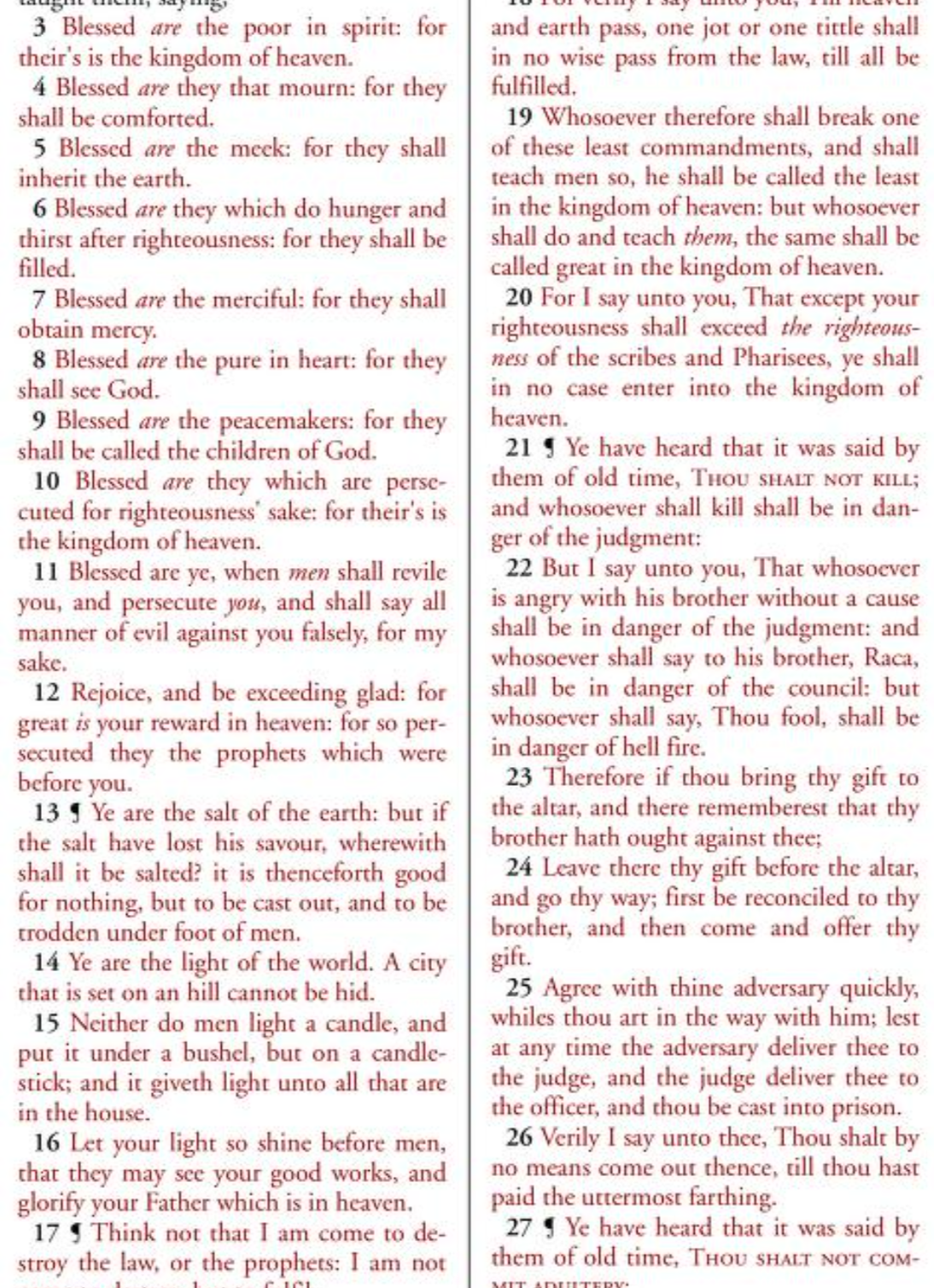
I remember the first time the red letters in the Gospels truly caught my eye. As a child, when I first dedicated myself to Jesus, those words in red touched me deeply. In my youthful simplicity, I thought: Well, that’s all you really need to be a good Christian. Just follow the red letters. Decades later, in my heart of hearts, I still believe that today. Everything else is just commentary.
When I look at those red letters of Scripture now, I am reminded that they are not mere decorations on a page. They are not gentle suggestions. They are a summons.
“Follow me.”
“Love God.”
“Love your neighbor.”
“Love your enemies.”
“Love one another as I have loved you
“Take up your cross.”
“Feed my sheep.”
I cannot read those words honestly and remain comfortable. They demand that my life be reordered, not around my personal preferences, but around obedience. I cannot just admire Him or preach about Him. I must actually follow Him.
To embrace this universal, Christ-centered identity does not mean I reject tradition. Far from it. I honor the sacraments. I deeply value the Church. I recognize that I stand within a vast, historic stream of apostolic faith. But I must never confuse the stream with the Source. The moment I let any expression of my faith demand my loyalty above the clear teachings of Jesus, I know I have drifted.
At the heart of it all, Christ gives me a beautifully simple image that cuts through all the complexity I tend to create:
“Happy is that servant who is found at his task when his master comes.” Luke 12:43
I admit that the language of “master and servant” often unsettles my modern ears. My instinct is to crave autonomy, control, and self-direction. But Christ offers me something far better than control: He offers clarity.
If I can learn to govern myself simply as a servant of the Master, I will always know what God expects of me. A servant doesn’t wake up each morning having an identity crisis. He already knows who he is. He belongs. And because he belongs, he has a purpose.
This is where my path as a Christ Catholic finds its practical, daily rhythm in the Sacramental Community of the Coworkers of Christ. As a part of this new monastic tradition, the call to servanthood isn’t just a metaphor; it is a shared vocation. To be a “coworker” literally means I am called to take up the shared tasks of the Master alongside others.
As a Coworker of Christ, I already know the work set before me. The hard truth I must face is that my problem is rarely confusion; my problem is reluctance. I know I am called to forgive, to tell the truth, to care for the poor, to pray without ceasing, and to remain faithful in the small things. My monastic life is not about constantly searching for a grand new task, but about doing the ordinary tasks faithfully, thoroughly, and with care. And when the work is done, I do not need to build a monument to my own effort. I simply look for the next thing that needs doing, quietly and without fanfare.
There is a profound freedom in this shared rule of life, a freedom the world does not understand. As a servant and a Coworker, I do not have to carry the burden of whether my work has ultimate value. That burden belongs to the Master. God has taken the weight of the outcomes upon Himself.
Whether the work of our Sacramental Community succeeds or fails in the eyes of the world, whether it is seen or hidden, whether it is finished or left incomplete those are not my concerns. That is not my lane. My only work is daily, ordinary, faithful obedience. My success is found only in my affirmation of Christ’s call to me: yes, Lord, yes, to your will and to your way. Literally nothing else matters.
To live this monastic tradition authentically means I must hold my assignments lightly. I cannot cling to my work, guard it, or pridefully say, “This is my ministry.” If I build my ego around it, I lose the plot of what it means to be a Coworker. At any moment, the Master may return, or He may ask me to pivot. I must be ready to drop everything, to listen, to move, to follow. No arguments. No negotiations. Just readiness.
In the end, the measure of my life will not be how impressive my work appears. It will simply be whether I was faithful to the Master. Not successful. Not celebrated. Not even understood. Just faithful.
My calling as a Christ Catholic, lived out in the Coworkers of Christ, is demanding, but it is beautifully uncomplicated: Return to the red letters. Follow the living Christ. Take my place not as an owner, but as a Coworker and servant to the universal Lord. Do the work given to me today, and leave the rest to God.
Because when the Master comes, there is only one question that will matter: Will He find me quietly at my task?