

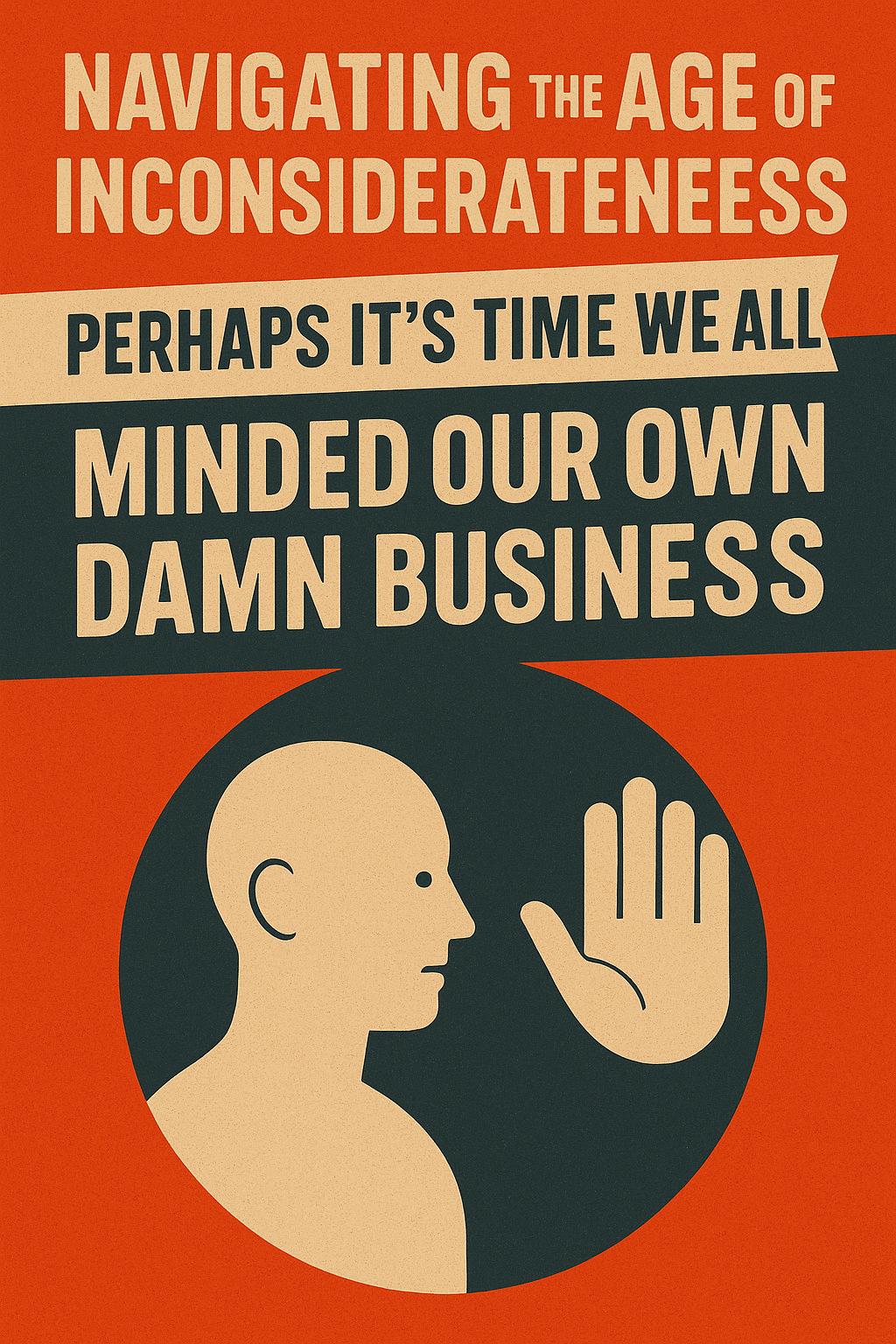
Navigating the Age of Inconsiderateness: Perhaps It’s Time We All Minded Our Own Damn Business
Emerging from the postmodern era, characterized by its skepticism towards grand narratives, embrace of fragmentation, and often ironic stance, the rapid ascent into digimodernism, fueled by ubiquitous digital technology and hyper-connectivity, initially seemed to intensify this fragmentation while offering new possibilities for connection and information access. Yet, this digital landscape, with its speed, anonymity, and algorithmic amplification, has evolved with startling speed into what feels increasingly like an Age of Inconsiderateness. In this phase, the detachment and relativism of postmodernism, combined with the instantaneity and performative nature of digital platforms, often manifest as a casual disregard for nuanced understanding, an erosion of empathy in online interactions, quick and often harsh judgments, and the widespread dissemination of information (or misinformation) without apparent concern for its accuracy or impact on individuals and civil discourse.
Be that as it may, there’s a sentiment bubbling just beneath the surface for many, and increasingly, spilling over into our daily interactions: we seem to be navigating a full on Age of Inconsiderateness. From the moment we merge onto the highway to the way we discuss national policy, and even in our quiet judgments of how others choose to live, a pervasive lack of regard for one another is palpable. It’s exhausting, it’s frustrating, and frankly, it’s time we collectively embraced an old, yet strikingly relevant, piece of wisdom: mind your own damn business.
Let’s start with the daily gauntlet that is commuting. Inconsiderate, aggressive driving isn’t just a nuisance; it’s a genuine threat. We’ve all seen it, and many of us have, regrettably, participated. Tailgating so close you can read the other driver’s last oil change sticker, weaving through traffic like a stunt double in a low-budget action film, cutting others off without a signal, and the ever-present chorus of angry honking. Statistics paint a grim picture. According to The Zebra, a staggering 96% of drivers witnessed an act of road rage in the past six months in 2024, and 82% of U.S. drivers admitted to having road rage or driving aggressively at least once in the past year. The AAA Foundation for Traffic Safety reported that nearly 80% of drivers expressed significant anger, aggression, or road rage behind the wheel at least once in the previous 30 days. This isn’t just bad manners; it’s dangerous. The National Highway Traffic Safety Administration (NHTSA) has noted that aggressive driving can contribute to a significant percentage of traffic fatalities. The root? Often, it’s a potent cocktail of stress, a feeling of anonymity behind the wheel, and a fundamental lack of consideration for the safety and peace of mind of fellow human beings sharing the road. We treat driving as a zero-sum game, forgetting that the “opponent” is a person, likely just trying to get to work or home, just like us.
This confrontational spirit bleeds heavily into our political discourse. Rational debate has been largely supplanted by vitriolic shouting matches, often online, where anonymity emboldens the worst in us. Social media platforms, as highlighted by a 2023 American Bar Association survey, are seen by many as primary culprits in eroding civility. The survey found 85% of respondents believe civility is worse than it was 10 years ago, with 29% blaming social media and another 24% blaming the media generally. Instead of engaging with differing viewpoints, we retreat into echo chambers that reinforce our own biases. Political opponents are no longer just people with different ideas; they are vilified, stripped of their humanity, and seen as “the enemy.” This “us vs. them” mentality, as explained by Social Identity Theory, leads to in-group cohesion and out-group discrimination. The result is legislative gridlock, an erosion of trust in democratic institutions, and a society where constructive dialogue feels like a relic of a bygone era. We’ve become so entrenched in our own rightness that we’ve forgotten the art of listening, of compromise, and of simply acknowledging the legitimacy of another person’s perspective, even if we fundamentally disagree.
Our disregard extends, noticeably, to other people’s property as well. This isn’t just about grand theft or vandalism, but the everyday acts of carelessness and entitlement that signal a lack of respect for what belongs to others. Think of litter casually tossed onto someone’s lawn, borrowed items returned damaged or not at all, or the assumption that public or shared spaces are personal dumping grounds. This type of inconsiderateness ranges from playing loud music that invades a neighbor’s peace to allowing pets to foul public walkways, or even minor acts like not returning shopping carts. Each instance, while perhaps small on its own, contributes to a broader sense of disrespect and erodes the social contract that relies on mutual consideration for personal and communal belongings. It reflects a me-first attitude where the impact on others and their possessions simply doesn’t register, or worse, is wilfully ignored.
Then there’s the profound disrespect shown for other people’s time, a finite resource we all share. Being chronically late for appointments, meetings, or social gatherings without a thought for the schedules of others is a hallmark of this particular brand of inconsiderateness. It communicates that your time is more valuable than theirs. This can manifest in constantly interrupting conversations, monopolizing someone’s attention, failing to RSVP, or canceling plans at the last minute with little or no explanation. In a professional context, it can mean scheduling last-minute meetings that disrupt workflow or failing to respond to communications in a timely manner, thereby impeding progress. Each stolen minute, each disrupted schedule, is a small tear in the fabric of mutual respect that should govern our interactions.
Beyond tangible assets and time, there’s an alarming rise in the inconsiderate dismissal of other people’s feelings and lived experiences. This emotional invalidation, whether intentional or not, can be incredibly damaging. It’s the “you’re too sensitive” when someone expresses hurt, the “it could be worse” when they share a struggle, or the outright denial that their experience (“that didn’t happen”) is legitimate. This lack of empathy, sometimes fueled by an inability to see beyond our own perspectives or discomfort with others’ emotions, chips away at connection and understanding. Studies have even pointed to a decline in empathy over recent decades. When we refuse to acknowledge or make space for another person’s emotional reality or the validity of their life path, we contribute to an environment of isolation and misunderstanding, making genuine human connection increasingly difficult.
And then there’s the more subtle, yet equally corrosive, inconsiderateness we show towards others’ personal lifestyle choices. Whether it’s diet, career path, relationship status, parenting philosophies, or how someone chooses to spend their leisure time, unsolicited opinions and judgments abound. This can manifest as overt criticism or passive-aggressive comments, often stemming from our own insecurities or a rigid adherence to societal norms. Psychologists suggest that inconsiderate behavior often means not considering how our actions impact other people. It can be learned in childhood or exacerbated by stress and mental health challenges. This constant, low-humming judgment creates an atmosphere where individuals feel scrutinized and pressured to conform, rather than supported in their pursuit of a life that brings them fulfillment. The truth is, unless someone’s choices are directly harming others, their path is theirs to walk. Our energy is far better spent tending to our own gardens than critiquing how others landscape theirs.
This brings us to that wonderfully blunt, yet profoundly wise, adage: “Mind your own damn business.” Most recently made popular by Governor Tim Walz of Minnesota but originally traced back to thinkers like Sir Francis Bacon in the 17th century, its core message remains as potent as ever. It’s not a call for apathy or a complete disengagement from society. Rather, it’s an invitation to refocus our energies. It means not imposing our will, our anxieties, or our worldview onto others unnecessarily. It means allowing people the space to make their own decisions, to learn from their own mistakes, and to live their lives according to their own values, as long as they are not infringing on the rights and safety of others.
Imagine a world where, before aggressively honking, we took a breath. Before firing off that scathing political comment online, we considered the human on the other side. Before leaving our trash on someone else’s property, making someone wait indefinitely, or dismissing another’s heartfelt experience, we thought about how we’d feel. Before judging a lifestyle choice that differs from our own, we remembered our own imperfections and unique journey.
The “Age of Inconsiderateness” isn’t a foregone conclusion. It’s a trend, and trends can be reversed. It starts with a conscious, individual effort to be more mindful, more empathetic, and yes, more willing to simply mind our own damn business. Perhaps then, we can collectively dial down the hostility and rediscover the common courtesy that makes for a more livable, and frankly, more pleasant society for everyone.
There’s still hope, if only we’ll mend our wicked ways!
Love, +B