

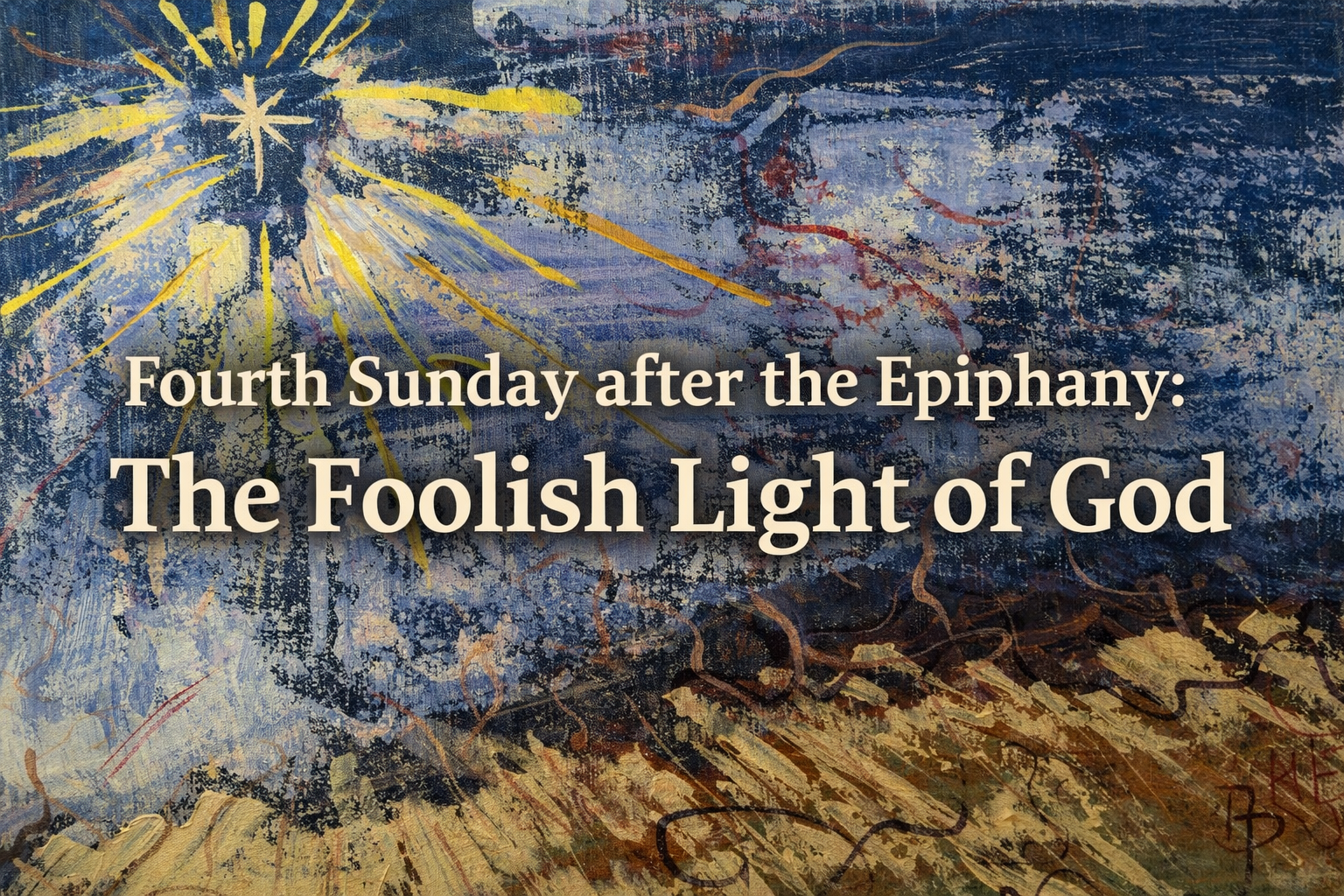
Fourth Sunday after the Epiphany: “The Foolish Light of God”
Micah 6:1–8 • Psalm 15 • 1 Corinthians 1:18–31 • Matthew 5:1–12
By +Brian Ernest Brown, CWC
The Collect:
Almighty and everlasting God, you govern all things both in heaven and on earth: Mercifully hear the supplications of your people, and in our time grant us your peace; through Jesus Christ our Lord, who lives and reigns with you and the Holy Spirit, one God, for ever and ever. Amen.
Old Testament: Micah 6:1-8
Hear what the Lord says: Rise, plead your case before the mountains, and let the hills hear your voice. Hear, you mountains, the controversy of the Lord, and you enduring foundations of the earth; for the Lord has a controversy with his people, and he will contend with Israel. “O my people, what have I done to you? In what have I wearied you? Answer me! For I brought you up from the land of Egypt, and redeemed you from the house of slavery; and I sent before you Moses, Aaron, and Miriam. O my people, remember now what King Balak of Moab devised, what Balaam son of Beor answered him, and what happened from Shittim to Gilgal, that you may know the saving acts of the Lord.” “With what shall I come before the Lord, and bow myself before God on high? Shall I come before him with burnt offerings, with calves a year old? Will the Lord be pleased with thousands of rams, with ten thousands of rivers of oil? Shall I give my firstborn for my transgression, the fruit of my body for the sin of my soul?” He has told you, O mortal, what is good; and what does the Lord require of you but to do justice, and to love kindness, and to walk humbly with your God?
Psalm: Psalm 15
Lord, who may dwell in your tabernacle? *
who may abide upon your holy hill?
Whoever leads a blameless life and does what is right, *
who speaks the truth from his heart.
There is no guile upon his tongue;
he does no evil to his friend; *
he does not heap contempt upon his neighbor.
In his sight the wicked is rejected, *
but he honors those who fear the Lord.
He has sworn to do no wrong *
and does not take back his word.
He does not give his money in hope of gain, *
nor does he take a bribe against the innocent.
Whoever does these things *
shall never be overthrown.
Epistle: 1 Corinthians 1:18-31
For the message about the cross is foolishness to those who are perishing, but to us who are being saved it is the power of God. For it is written, “I will destroy the wisdom of the wise, and the discernment of the discerning I will thwart.” Where is the one who is wise? Where is the scribe? Where is the debater of this age? Has not God made foolish the wisdom of the world? For since, in the wisdom of God, the world did not know God through wisdom, God decided, through the foolishness of our proclamation, to save those who believe. For Jews demand signs and Greeks desire wisdom, but we proclaim Christ crucified, a stumbling block to Jews and foolishness to Gentiles, but to those who are the called, both Jews and Greeks, Christ the power of God and the wisdom of God. For God’s foolishness is wiser than human wisdom, and God’s weakness is stronger than human strength. Consider your own call, brothers and sisters: not many of you were wise by human standards, not many were powerful, not many were of noble birth. But God chose what is foolish in the world to shame the wise; God chose what is weak in the world to shame the strong; God chose what is low and despised in the world, things that are not, to reduce to nothing things that are, so that no one might boast in the presence of God. He is the source of your life in Christ Jesus, who became for us wisdom from God, and righteousness and sanctification and redemption, in order that, as it is written, “Let the one who boasts, boast in the Lord.”
Gospel: Matthew 5:1-12
When Jesus saw the crowds, he went up the mountain; and after he sat down, his disciples came to him. Then he began to speak, and taught them, saying: “Blessed are the poor in spirit, for theirs is the kingdom of heaven. “Blessed are those who mourn, for they will be comforted. “Blessed are the meek, for they will inherit the earth. “Blessed are those who hunger and thirst for righteousness, for they will be filled. “Blessed are the merciful, for they will receive mercy. “Blessed are the pure in heart, for they will see God. “Blessed are the peacemakers, for they will be called children of God. “Blessed are those who are persecuted for righteousness’ sake, for theirs is the kingdom of heaven. “Blessed are you when people revile you and persecute you and utter all kinds of evil against you falsely on my account. Rejoice and be glad, for your reward is great in heaven, for in the same way they persecuted the prophets who were before you.
Fourth Sunday after the Epiphany: “The Foolish Light of God”
Beloved in Christ,
We prayed in the Collect today:
“Grant us your peace.”
Not the thin peace of avoidance.
Not the fragile peace of denial.
But the deep peace of God,
the peace that comes only when the world is set right,
when truth is spoken,
when justice is done,
when mercy is made flesh.
And that is exactly what today’s Scriptures are about.
They are not abstract.
They are not ornamental.
They are a summons.
God’s Controversy with His People
Micah opens with one of the most arresting scenes in all of Scripture:
The mountains are called as witnesses.
The hills are summoned to the courtroom.
Creation itself is asked to listen.
“Hear, you mountains, the controversy of the Lord.”
God has a case to plead against His own people.
And what is His accusation?
Not that they have failed to be religious enough.
Not that they have forgotten ritual.
But that they have forgotten righteousness.
God says:
“O my people… what have I done to you?
In what have I wearied you?”
It is the grief of a betrayed lover.
The sorrow of a faithful Shepherd.
“I brought you out of slavery,” God says.
“I redeemed you.”
“I guided you.”
“I saved you.”
And still… you wandered.
Still… you hardened your heart.
Still… you tried to replace covenant with performance.
So the people respond like anxious churchgoers often do:
“What should we do?
More offerings?
More sacrifice?
More religion?”
And God answers with holy simplicity:
“He has told you what is good.”
Not complicated.
Not hidden.
Not unreachable.
Do justice.
Love kindness.
Walk humbly with your God.
That is the requirement.
That is the way.
Who May Dwell in God’s House?
Psalm 15 asks the question we all must ask:
“Lord, who may dwell in your tabernacle?”
Who belongs near the Holy?
And the answer is not about incense or eloquence.
It is about integrity.
The one who speaks truth from the heart.
The one who does not heap contempt on a neighbor.
The one who does not exploit the vulnerable.
The one who does not take a bribe against the innocent.
In other words:
God’s house is not built for hypocrisy.
God’s presence is not a refuge for cruelty.
Worship that does not become mercy
is not worship at all.
The Cross: Wisdom That Looks Like Foolishness
And then Paul takes us even deeper.
“The message of the Cross is foolishness to those who are perishing…”
Of course it is.
Because the world is addicted to strength.
The world worships the successful, the loud, the untouchable.
The world crowns the winners and forgets the wounded.
But the Gospel says:
God saves the world
not through domination
but through self-giving love.
Not through violence
but through vulnerability.
Not through the throne
but through the Cross.
And Paul dares to proclaim:
God chose what is weak to shame the strong.
God chose what is low and despised…
Meaning:
God is not impressed with our power games.
God is not persuaded by status.
God is found among the poor, the forgotten, the ones the world calls “nothing.”
And this is Epiphany light, friends:
Christ is revealed not at the center of empire,
but at the margin.
Not in the palace,
but on the Cross.
The Mountain Where the Kingdom is Named
And then we arrive at Matthew.
Jesus climbs a mountain and sits down.
And what does He do?
He does not flatter the crowd.
He does not promise them comfort.
He names the Kingdom.
Blessed are the poor in spirit.
Blessed are those who mourn.
Blessed are the meek.
Blessed are those who hunger and thirst for righteousness.
Notice:
The Beatitudes are not sentimental.
They are revolutionary.
Jesus is announcing a world turned upside down.
A Kingdom where the mourners are not forgotten.
Where the merciful are not naïve.
Where peacemakers are not weak.
Where the persecuted are not abandoned.
In a world drunk on arrogance,
Jesus blesses humility.
In a world built on contempt,
Jesus blesses mercy.
In a world that rewards cruelty,
Jesus blesses the pure of heart.
The Beatitudes are not advice for self-improvement.
They are a prophetic unveiling:
This is what God calls holy.
The Epiphany Choice
So here we are.
Micah says: Do justice.
The Psalm says: Speak truth.
Paul says: Embrace the Cross.
Jesus says: Blessed are the merciful and the peacemakers.
And the question is unavoidable:
What kind of people will we be?
Will we be religious performers,
or covenant disciples?
Will we offer God sacrifices
while ignoring the suffering neighbor?
Will we chase the wisdom of the world
or kneel before the foolish wisdom of Christ crucified?
Will we bless what the world blesses…
or will we become Beatitude people?
Poor in spirit.
Hungry for righteousness.
Makers of peace.
Because here is the hard truth:
The Gospel does not fit neatly into the kingdoms of this age.
And if we live it truly,
the world may call it foolish.
But this foolishness is the power of God.
The Peace We Prayed For
We prayed:
“Grant us your peace.”
And now we see what that peace requires.
Justice.
Kindness.
Humility.
Truth.
The Cross.
The Beatitudes.
Not a comfortable Church.
A faithful one.
Not a triumphant Christianity.
A cruciform one.
So may we walk humbly.
Do justice.
Love mercy.
And may the strange, shining wisdom of Christ
be revealed in us:
as light in the darkness,
as peace in the turmoil,
as blessing in a battered world.
Amen.