
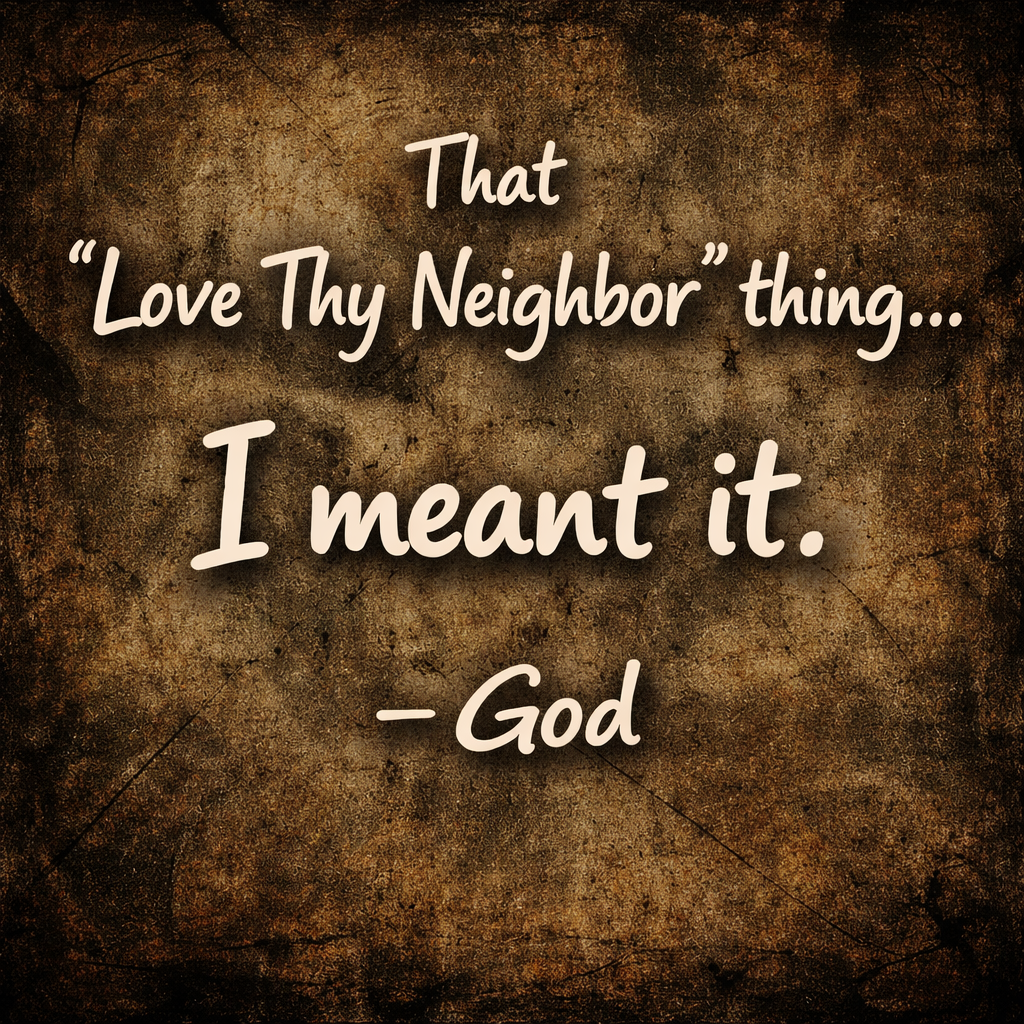
It’s easy enough to speak about loving one another when “one another” looks like us, thinks like us, or suffers alongside us. It is much harder when the “other” is someone we believe has caused deep harm, someone powerful, wealthy, insulated, and seemingly untouched by the consequences of their own decisions.
Jesus’ command to love our enemies sounds noble in the abstract. But what does that mean when the enemy is a public figure whose actions appear to wound the weak? What does love look like when those in authority seem indifferent, or worse, complicit, with the suffering of the vulnerable?
I struggle with that. I suspect I’m not alone.
Fr. Casey Cole, a Roman Catholic priest and Franciscan, recently made a video on this very topic, and though he and I do not always see eye to eye, this may be one of the best reflections he has offered. At least, it struck me that way. In fact, I found myself wishing I had made it.
Because he does not reduce love to approval. He does not confuse love with silence. And he does not pretend that justice doesn’t matter. Instead, he wrestles honestly with the command itself.
To love one’s enemy is not to excuse abuse. It is not to deny harm. It is not to surrender truth. It is, perhaps, to refuse hatred the final word and that is where the real work begins.
Loving those who harm others does not mean we stop resisting what is unjust. It does not mean we abandon the vulnerable. It does not mean we soften our critique of policies or actions that wound. It means we refuse to let our opposition turn into dehumanization. It means we refuse to let anger calcify into contempt.
That is extraordinarily difficult.
Because anger feels righteous. Hatred feels clarifying. Outrage feels powerful. But over time, those things reshape the heart. They begin to mirror the very hardness we claim to oppose.
So maybe loving enemies is less about changing them and more about guarding what happens inside us. Maybe it is about remembering that even those who wield power recklessly remain human, flawed, broken, accountable, but still human. And if we deny their humanity, something in ours begins to erode.
I do not say this easily. I say it with hesitation. I say it as someone who feels the tension deeply.
Can I love those who hurt and abuse the weak? I do not know that I can do it perfectly. But I know I am commanded to try, not for their sake alone, but for the integrity of my own soul.
Love does not cancel justice. Love does not erase consequences. Love does not protect the powerful from accountability. However, love refuses to become what it opposes and perhaps that is where discipleship gets real. Please pray for me.