

February 8, 2026
The Fifth Sunday after the Epiphany
Revised Common Lectionary
The Collect of the Day
Set us free, O God, from the bondage of our sins, and give us the liberty of that abundant life which you have made known to us in your Son our Savior Jesus Christ; who lives and reigns with you, in the unity of the Holy Spirit, one God, now and for ever. Amen.
The Readings
Isaiah 58:1-9a,(9b-12) – Psalm 112 – 1 Corinthians 2:1-12,(13-16) – Matthew 5:13-20
Isaiah 58:1-9a,(9b-12)
Shout out, do not hold back! Lift up your voice like a trumpet! Announce to my people their rebellion, to the house of Jacob their sins. Yet day after day they seek me and delight to know my ways, as if they were a nation that practiced righteousness and did not forsake the ordinance of their God; they ask of me righteous judgments, they delight to draw near to God. “Why do we fast, but you do not see? Why humble ourselves, but you do not notice?” Look, you serve your own interest on your fast day, and oppress all your workers. Look, you fast only to quarrel and to fight and to strike with a wicked fist. Such fasting as you do today will not make your voice heard on high. Is such the fast that I choose, a day to humble oneself? Is it to bow down the head like a bulrush, and to lie in sackcloth and ashes? Will you call this a fast, a day acceptable to the Lord? Is not this the fast that I choose: to loose the bonds of injustice, to undo the thongs of the yoke, to let the oppressed go free, and to break every yoke? Is it not to share your bread with the hungry, and bring the homeless poor into your house; when you see the naked, to cover them, and not to hide yourself from your own kin? Then your light shall break forth like the dawn, and your healing shall spring up quickly; your vindicator shall go before you, the glory of the Lord shall be your rear guard. [ Then you shall call, and the Lord will answer; you shall cry for help, and he will say, Here I am. If you remove the yoke from among you, the pointing of the finger, the speaking of evil, if you offer your food to the hungry and satisfy the needs of the afflicted, then your light shall rise in the darkness and your gloom be like the noonday. The Lord will guide you continually, and satisfy your needs in parched places, and make your bones strong; and you shall be like a watered garden, like a spring of water, whose waters never fail. Your ancient ruins shall be rebuilt; you shall raise up the foundations of many generations; you shall be called the repairer of the breach, the restorer of streets to live in.]
Psalm 112:1-9,(10)
Hallelujah!
Happy are they who fear the Lord *
and have great delight in his commandments!
Their descendants will be mighty in the land; *
the generation of the upright will be blessed.
Wealth and riches will be in their house, *
and their righteousness will last for ever.
Light shines in the darkness for the upright; *
the righteous are merciful and full of compassion.
It is good for them to be generous in lending *
and to manage their affairs with justice.
For they will never be shaken; *
the righteous will be kept in everlasting remembrance.
They will not be afraid of any evil rumors; *
their heart is right;
they put their trust in the Lord.
Their heart is established and will not shrink, *
until they see their desire upon their enemies.
They have given freely to the poor, *
and their righteousness stands fast for ever;
they will hold up their head with honor.
[The wicked will see it and be angry;
they will gnash their teeth and pine away; *
the desires of the wicked will perish.]
1 Corinthians 2:1-12,(13-16)
When I came to you, brothers and sisters, I did not come proclaiming the mystery of God to you in lofty words or wisdom. For I decided to know nothing among you except Jesus Christ, and him crucified. And I came to you in weakness and in fear and in much trembling. My speech and my proclamation were not with plausible words of wisdom, but with a demonstration of the Spirit and of power, so that your faith might rest not on human wisdom but on the power of God. Yet among the mature we do speak wisdom, though it is not a wisdom of this age or of the rulers of this age, who are doomed to perish. But we speak God’s wisdom, secret and hidden, which God decreed before the ages for our glory. None of the rulers of this age understood this; for if they had, they would not have crucified the Lord of glory. But, as it is written, “What no eye has seen, nor ear heard, nor the human heart conceived, what God has prepared for those who love him”– these things God has revealed to us through the Spirit; for the Spirit searches everything, even the depths of God. For what human being knows what is truly human except the human spirit that is within? So also no one comprehends what is truly God’s except the Spirit of God. Now we have received not the spirit of the world, but the Spirit that is from God, so that we may understand the gifts bestowed on us by God. [ And we speak of these things in words not taught by human wisdom but taught by the Spirit, interpreting spiritual things to those who are spiritual. Those who are unspiritual do not receive the gifts of God’s Spirit, for they are foolishness to them, and they are unable to understand them because they are spiritually discerned. Those who are spiritual discern all things, and they are themselves subject to no one else’s scrutiny. “For who has known the mind of the Lord so as to instruct him?” But we have the mind of Christ.]
Matthew 5:13-20
“You are the salt of the earth; but if salt has lost its taste, how can its saltiness be restored? It is no longer good for anything, but is thrown out and trampled under foot. “You are the light of the world. A city built on a hill cannot be hid. No one after lighting a lamp puts it under the bushel basket, but on the lampstand, and it gives light to all in the house. In the same way, let your light shine before others, so that they may see your good works and give glory to your Father in heaven. “Do not think that I have come to abolish the law or the prophets; I have come not to abolish but to fulfill. For truly I tell you, until heaven and earth pass away, not one letter, not one stroke of a letter, will pass from the law until all is accomplished. Therefore, whoever breaks one of the least of these commandments, and teaches others to do the same, will be called least in the kingdom of heaven; but whoever does them and teaches them will be called great in the kingdom of heaven. For I tell you, unless your righteousness exceeds that of the scribes and Pharisees, you will never enter the kingdom of heaven.
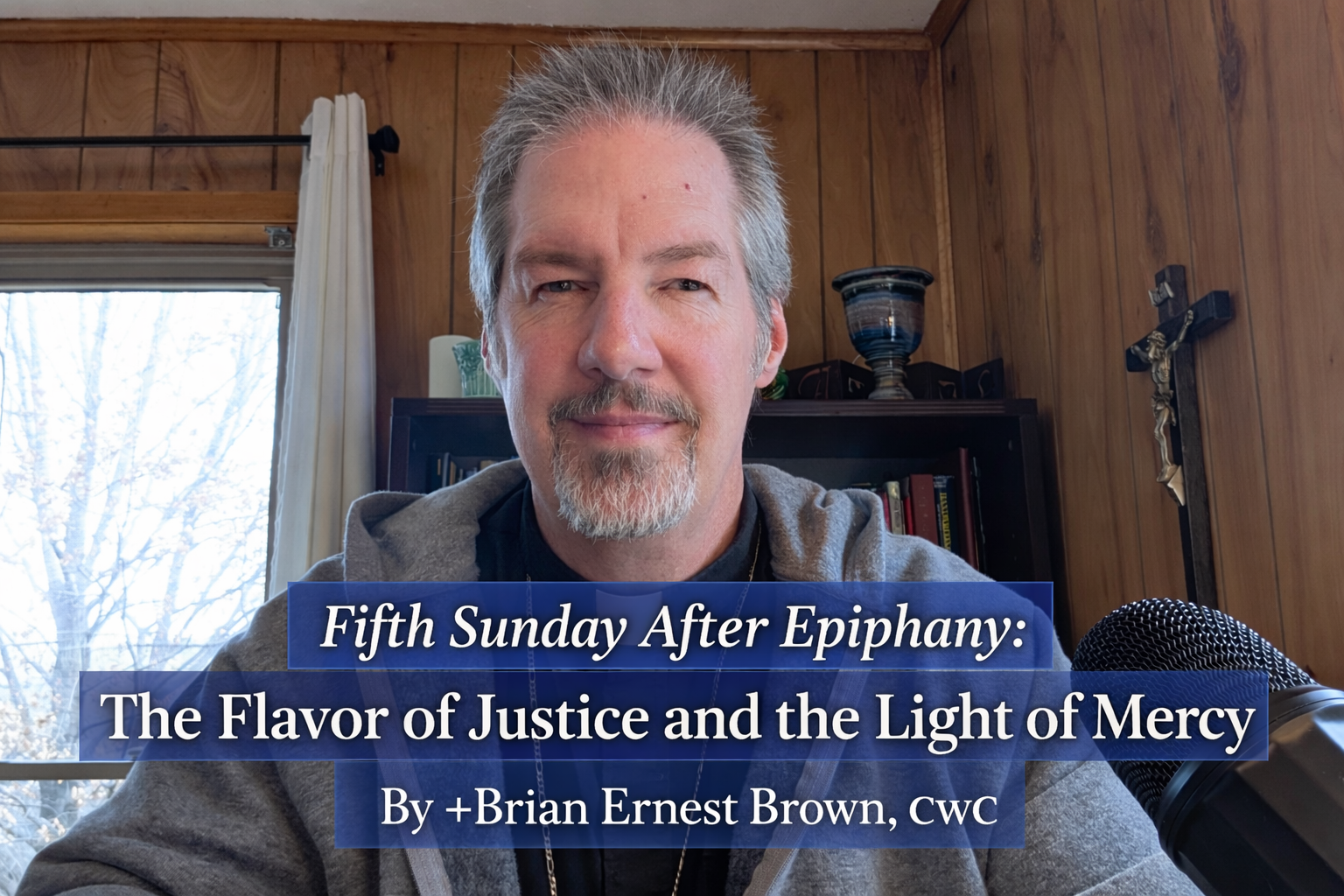
The Flavor of Justice and the Light of Mercy
By +Brian Ernest Brown, CWC
There is a distinct difference between a museum and a kitchen.
In a museum, things are kept behind glass. They are preserved, untouched, spotless, and safely separated from the mess of ordinary life. They exist to be admired, not handled. A museum invites reverence from a distance.
A kitchen is different. In a kitchen, ingredients are meant to be used. They are chopped, mixed, scattered, dissolved, heated, and consumed. They are not there to be admired. They are there to change the chemistry of the meal.
In today’s Gospel, Jesus looks at his disciples, and at us, and he makes a startling announcement. He does not say, “You are the museum pieces of the earth.” He says, “You are the salt of the earth.”
And he does not say, “You are the spotlight on the stage.” He says, “You are the light of the world.”
Both salt and light share something essential in common: they are useless if they keep to themselves. Salt that stays in the shaker preserves nothing and flavors nothing. Light hidden away in a box illuminates nothing. From the thundering voice of Isaiah to the quiet authority of Jesus on the mountain, today’s readings press us toward the same uncomfortable truth: faith that remains safely contained is faith that fails its purpose.
God is not building a museum. God is preparing a meal.
Isaiah 58 is one of the most bracing critiques of religious performance in all of Scripture.
The people of Israel are confused and frustrated. They are doing all the outwardly correct things. They are fasting. They are humbling themselves. They are bowing their heads and wearing the right expressions of piety. And yet God feels distant. They cry out, “Why do we fast, but you do not see? Why humble ourselves, but you do not notice?”
God’s response is not gentle. It is clarifying.
In essence, God says: I see your rituals, but I also see your lives. While they were fasting to appear holy, they were exploiting their workers. While they were praying, they were quarreling and striking one another. They had separated worship from ethics, devotion from justice. Their faith had become performative. They looked religious, but they tasted like dust.
They had become salt that had lost its savor.
So God redefines worship for them, not as a feeling, not as a posture, not as a private discipline but as a public way of life.
“Is not this the fast that I choose,” God asks, “to loose the bonds of injustice, to undo the thongs of the yoke, to let the oppressed go free?”
“Is it not to share your bread with the hungry, and bring the homeless poor into your house?”
Isaiah teaches us something deeply unsettling and deeply freeing: if we want to find God, we will not find Him only by looking upward in prayer. We will find Him when we look sideways, into the face of the neighbor, especially the one who is hungry, afflicted, or ignored.
And when that happens, Isaiah promises, “Your light shall break forth like the dawn.”
This brings us back to Jesus and his words on the mountaintop.
When Jesus calls his disciples salt, he is calling them to be agents of preservation and flavor in a world already showing signs of decay. In the ancient world, salt slowed rot. It kept food from spoiling. Christians are called to slow the rot of hatred, cruelty, dishonesty, and neglect. Wherever we are present, something should be preserved.
Salt also enhances flavor. It brings out what is already there. A follower of Christ should make life more humane for the people around them. There should be more joy, more patience, more generosity, more mercy simply because we are in the room.
But Jesus issues a warning: “If salt has lost its taste, how can its saltiness be restored?”
Pure salt does not actually lose its saltiness, but ancient salt was often mixed with impurities. When the true salt washed away, all that remained was dust—white, religious-looking, but useless.
When we prioritize comfort over justice, appearance over mercy, or loyalty to our political tribes over loyalty to the Gospel, we become the dust. We still look like the Church. We just no longer taste like Christ.
Light works the same way. It is meant to be exposed, not concealed. A lamp hidden away helps no one. Faith that never risks visibility cannot heal a darkened world.
Isaiah offers us one of the most beautiful vocations in all of Scripture. He says that if we feed the hungry, tend the afflicted, and refuse the pointing of the finger and the speaking of evil, we will be called “repairers of the breach, restorers of streets to live in.”
Our world is full of breaches.
There is a breach between the rich and the poor.
A breach between political factions.
A breach between races and cultures.
A breach between the genders.
A breach between humanity and the earth itself.
The Church is not called to widen these gaps with outrage and accusation. We are called to stand in them. To hold the tension. To repair rather than inflame.
St. Paul reminds us that we do not do this work through cleverness or dominance. He says plainly, “I did not come proclaiming the mystery of God with lofty words or wisdom.” We do not heal the world because we are smarter than others. We heal it because we have received the mind of Christ, a mind shaped by humility, sacrifice, and love poured out.
The same Spirit that led Jesus to touch the leper and eat with sinners is the Spirit entrusted to us.
The Collect for today prays that God would set us free from the bondage of sin and give us the liberty of abundant life.
We often imagine abundant life as comfort, security, or success. But the Scriptures today tell a different story. Abundant life is not found in holding on, but in being poured out.
Salt fulfills its purpose when it dissolves.
A candle fulfills its purpose when it burns away the wax.
And the Christian fulfills their purpose when they give themselves for the life of the world.
So this week, do not be content to stay in the shaker. Do not hide beneath the bushel basket. Look for the breach in the wall, the place where things are broken, divided, or fraying and stand there. Bring the mortar of kindness. Bring the bricks of justice. Bring the light that does not belong to you but shines through you.
And trust that in giving yourself away, you will discover the freedom Christ has already promised.
Amen.